Thursday, April 13, 2006

Small Boats


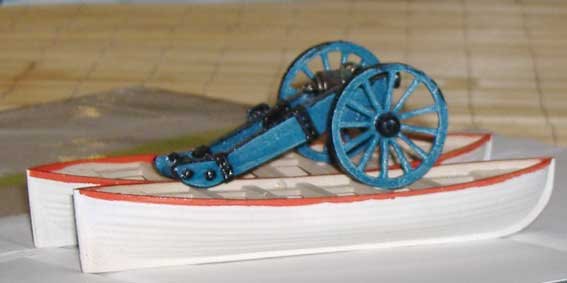
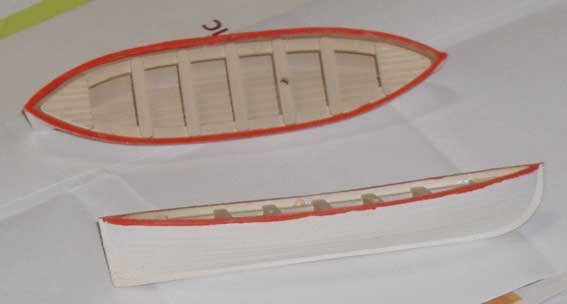
This morning I finished painting the first two of my five small boats. I intend that they'll be fairly versatile, being used as pontoon bridges, ferries &c.

In the latter role, I will build a small, detatchable deck to run a gun or other stores onto.

This leads me to think that it is time foe me to create a corps of pontoniers and recruit some engineers.

Furthermore, I might have to get some gabions - I'm thinking of building a pair of battery positions for some siege artillery. Can anyone suggest a method of manufacture or, failing this, a manufacturer?

Wednesday, April 12, 2006

A few random thoughts...

I am sitting in the room I have set (for the moment! temporarily!) aside for laying out the fortress.

Looking carefully at it, it came to me that if I were to complete the circuit of the walls, I would have a pentagonal fortress of five bastions on my hands. Perhaps this could be a future project - I would need another two bastions and two lengths of wall. What's that? A week and-a-half's work? The two half-bastions I have go together reasonably neatly. Not perfectly, but not too badly.

The next thought that came to me was that it would be immensely cool to complete that circuit, and set the fortress up on a table with a hatch in the middle and be able to poke my head through it (a la Peter Young) and survey the field from within my fastness.

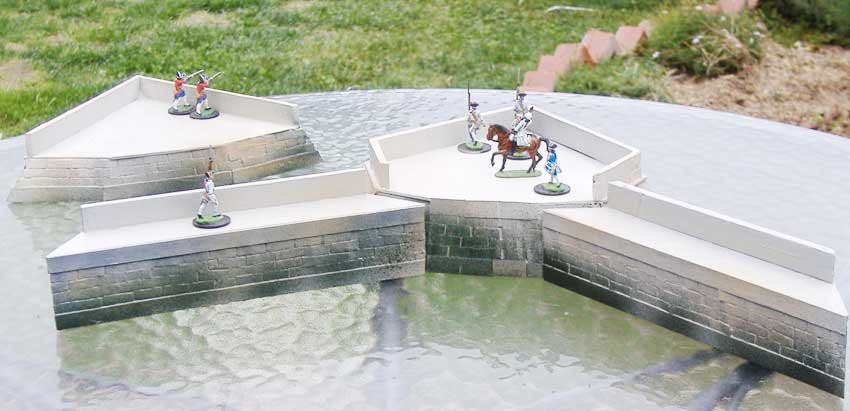
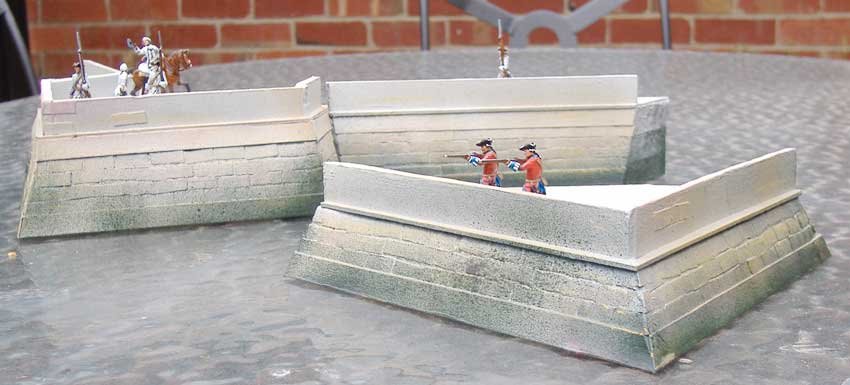
More Finished Components


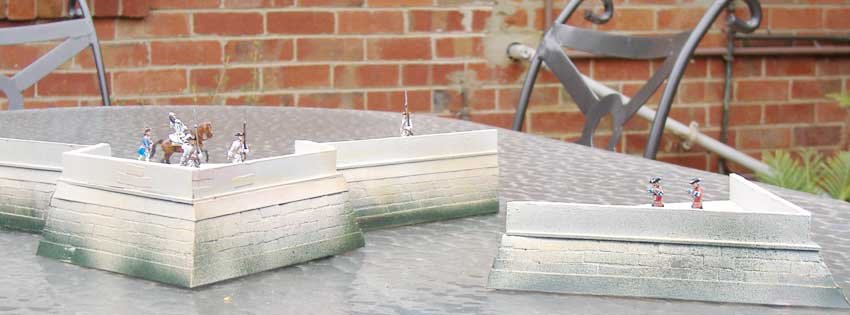
As you can see all components of the fort for this round, barring the gatehouse, are complete. I'm a little concerned by the darkness of the green in some places, so I'll probably do a couple of light over-spraus of tan here and there. I'm very pleased wth the effect of the tan overspray on the pale ivory-gray base colour.

The gatehouse needs to be taller... and the great big step thing out the front of it needs to go.

Monday, April 10, 2006

Fortress Progress

This morning I finished undercoating the last demi-bastion and also finished card-cladding the last full bastion.

With luck thise two components ought to be finished by this time tomorrow. The rest of the week should see me getting onto building the gate-house. The basic shape is there in polystyrene, and I have some old Brettonian shields and parts from a Prince August cannon casting for a crest and a trophy of arms to dress it with. I'll probably use some old mounting board I have to do the gateway with, and some dowel to form the ornamental pillars.

The last job will be to build some gun platforms for the artillery I intend to mount on the fortress. I've had the guns for a while, Hinchcliffe 24pdrs on fortress mounts - but only four of them. I think I'll buy another four to fully arm the fortress.

Then that'll be it. All done.

For my next project I intend to put together a glacis for the fortress. Also, I bought some model boats on the weekend. I got five of them for $AU17.50 (multiply by about 0.74 or divide by 2.4 to get the $US or GBP figures respectively) from a place that sells model boat bits. I thought they might make nice supports for a pontoon bridge. I'll let you know how that goes.

So here we are at this blog's 100th post.

Again, I want to thank everyone who has dropped by and taken a look or even left a comment, tip or hint.

Thanks to you all.

Sunday, April 09, 2006

Painting the Fortress

I've already mentioned that I undercoated the fortress in plack. The idea here was that should the painting miss any crevices , they would look shaded. As it turns out, I don't think i missed too many bits!

The model was painted in Tamiya spraypaints. Base coat was the palest gray I could find with a few oversprays of a slightly darler gray. I then painted back with the lighter gray to blend the darker in in places; the idea was just to vary the base colour a little. Spray-paints are great in terms of their very high quality finish, but so need to be broken up as this finish can look quite artificial.

The next layer of colour was some smallish, randomly-applied patches of a light tan which I applied to about 30% of the models' vertical surfaces, not being too bothered is some went onto the horizontal surfaces, but not aiming for it either. Finally I sprayed areas of green patchily onto the bottom fo the vertical surfaces, allowing it to drift 'up' a little to simulate algae and other water-borne nastiness that you might get if the fortress was standing in a wet moat.

The last touch was to rub some chalk pastel onto my finger-tips and then roughly over all the raised areas of the model. Some red, orange and yellow ochre. Less is more here and the idea should be to apply tiny patches of pure colour to slightly brighten what to now has been a fairly dull colour palette.

The chalk was sealed in place with a spray fixitave which can be got from any art store. This needs to be done because dry chalk pastel rubs off very easily.

Painted Fortress Elements


Thursday, April 06, 2006

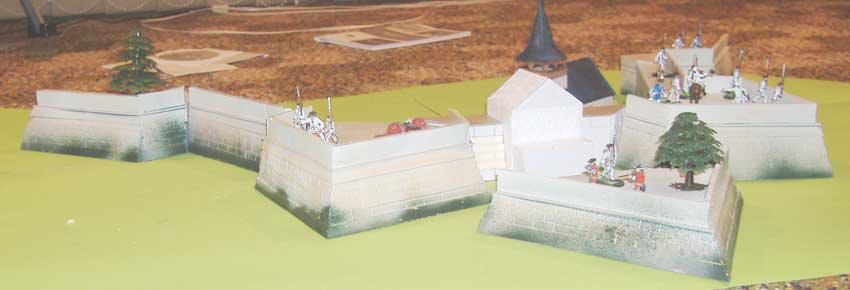
Mirenburg's Bastioned Walls. (Baedecker, 1977)


Again, Colonel de Castel-Jaloux dominates the scene, but the view is somewhat refreshed by a nice prospect of the tower of the Kleine Kirche. This slender structure stands in interesting (and perhaps somewhat Phallic) counterpoint to the masculine bulk of the North and North-Eastern bastins that flank the Kings' gate and it's famous, leafy parapet walks.

Completed front of Fortification


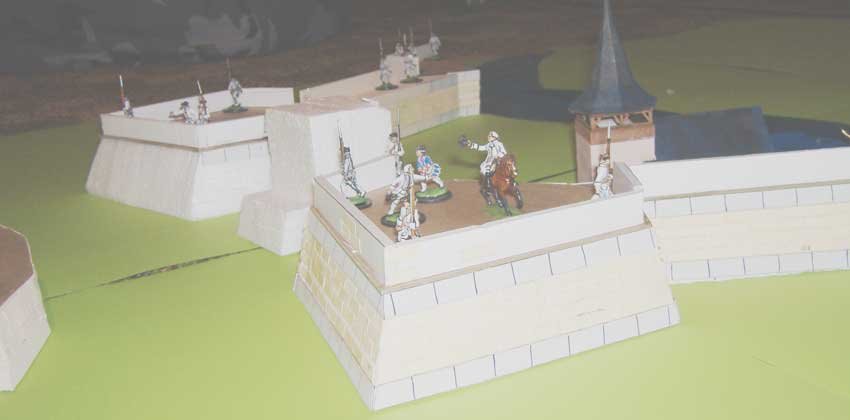
This image shows a bastion, a length of curtain wall and a demi-bastion virtually complete but for the sealing of the exposed edges of the foamcore.

The need to be undercoated to stop the pale gray spray-on base-coat from dissolving the polystyrene sub-structure. I admit that I considered this as a means of producing a breached section!

I feel that this image gives something of the same impression of almost inhuman massiveness that the real thing may have had.

That is Carbon de Castel-Jaloux there, greeting one of his under-officers, Captain Bellerose.

More Fortress Pix


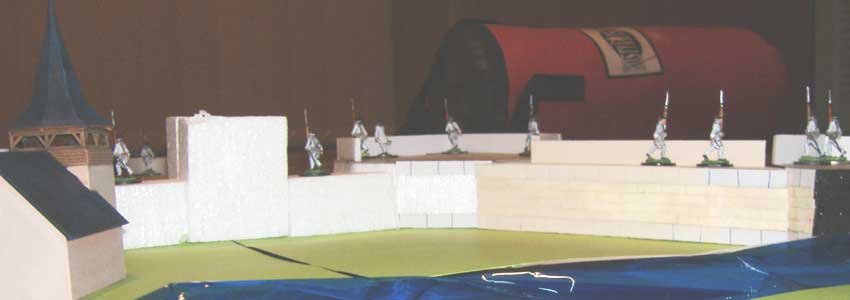
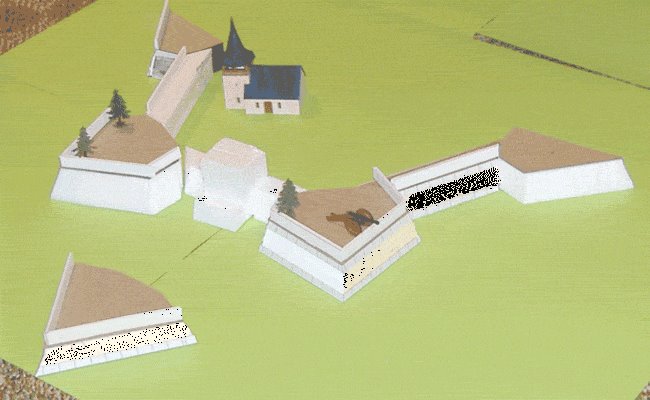
I hope this image shows the process which I have gone through to prepare this terrain item. From the middle of the picture we see the bare polystyrene of the gatehouse; in the centre-right is the wall with mock-ashlar masonry, heavy card platform and foamcore parapet; while on the far right is the fully clad wall and demi-bastion with the bricks made from manila folders put through a document shredder!

At the left of the picture is the Kliene Kirche, a HO railway accessory from "Kibri".

Click on this image (or any other of course) for a larger version.

Wednesday, April 05, 2006

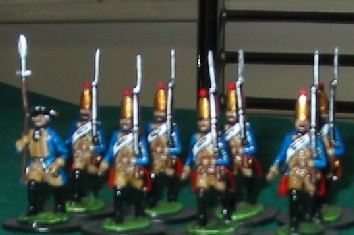
DPC French Infantry


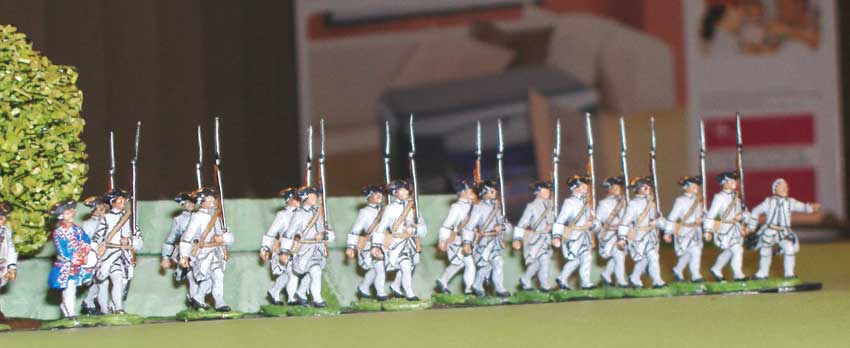
Representing the Bourbonnois reiment, this company (in the "Charge!" organisation) is made with DPC French infantry - marching pose.

New Purchases

Today I finally surrendered to temptation and bought a couple of books from Amazon.

They are "Prussia's Glory" (following a word of praise from Bill P.) and "Instrument of War", both by Prof. Christopher Duffy. The former is an analysis of Rossbach and Leuthen, the latter a masterly in-depth survey of the administration and organsation of the Royal and Imperial Austro-Hungarian Army.

I'm looking forward to these! To go with "Instrument of War" one day I'd love to get my hands on Lee Kennett's 1967 treatment of the French Army as an institution. I read -and photocopied large chunks of it - at university in the late eighties.

While I'm on the subject of books, would anyone care to recommend a fairly modern work on the war of the Austrian Succession? Always been very interested in the conflict, but works on the subject are a bit thin here in Australia.

On the toy soldier front, I'm hoping to take delivery in a few weeks of a bag each of advancing French infantry and charging chevaux-legere from DPC. The Infantry will go towards the Volontaires de St Victor I mentioned earlier along with a few in the stand-and-fire and kneel-and-fire poses to give the less formal look I imagine the light corps of this era had. The cavalry, well, let's say that I have been rather inspired by a certain large cavalry "brigade" that has just had an airing in the USA.

Jim P. reckons DPC are thinking of doing some additional command figures (I'd love some french Officers and NCOs with pole-arms) and in addition, they are finding the odd Steve Hezzlewood mould they never knew they had. One being a seige howitzer. To my eyes this is of course rather opportune.

The sooner these items make the catalogue the better!

It's been brought to my attention this blog is getting recommended as one of the places to go for pix of the DPC 7YW range. I'll have to a) get some better pix up - I recognise that my photography skills weren't worth much in the earlier parts of this Blog and b) hit on DPC for some freebies!

Saturday, April 01, 2006

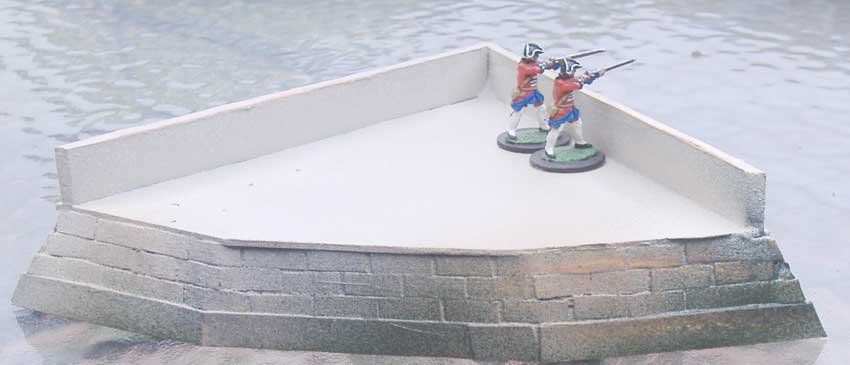
Wall detail


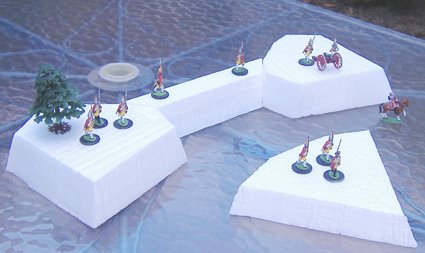
I think this shows the basic method I have used for detailing the basic slabs of polystyrene that make up the fortress; foamcore parapet, heavy card "roof" with a slight lip overhanging at the front. The card strips scored with a pen representing the heavy stonework and the thinner manila card chopped up with a shredder for the uniformity of effect making up the smaller "stones".

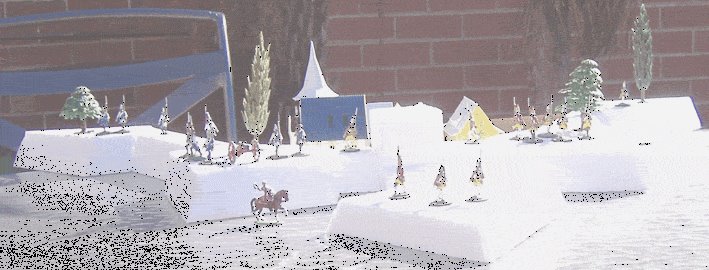
The mounted officer is that delightful raconteur Carbon de Castel-Jaloux.

I need more ravelins!


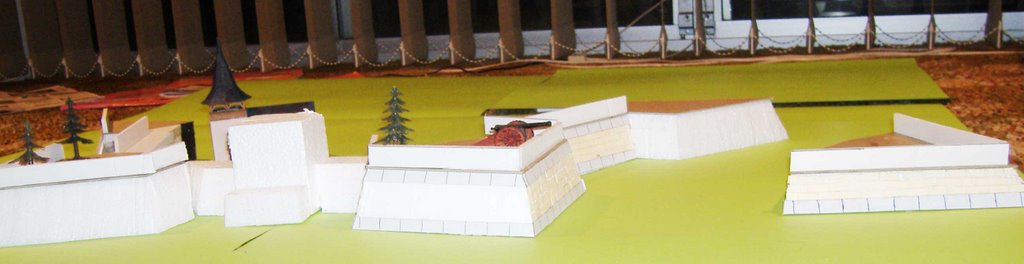
Low shot with my one ravelin repositioned to the right. I need more 30mm slabs of polystyrene!

The gatehouse looks more and more ordinary to me too. I might pull it to bits and start anew.

Fortress progress images


I hope these two images get across a general idea of how things are going. The two curtain walls are completed in all but the painting. The right-hand bastion is nearly there but for some card masonry. The left-hand one needs lots of masonry and part of the parapet to be done. The ravelin is done barring some card detail on it's rear face.

Given another week and all the fairly tedious detail work will be done.

The Kleine Kirche got painted when I couldn't take sticking little card rectangles down for another second one evening!

The gun is a "Willie" - the way cannon ought to be to my mind; big.

John Ray suggests using 25mm scale cannon with 30mm scale wheels. This is an idea I'd like to try out for looks.

I'm also starting to think it'd be cool to do little balsa gun platforms, and wooden paths on the insides of the parapets.

Blasthoff terrain bits


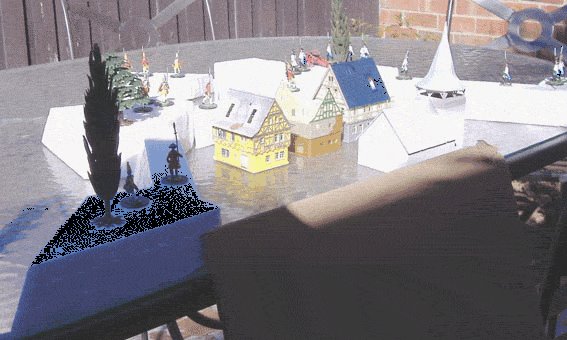
As I hope can be seen in this picture, I pretty well have all the terrain elements in place now that I need to do Blasthof with.

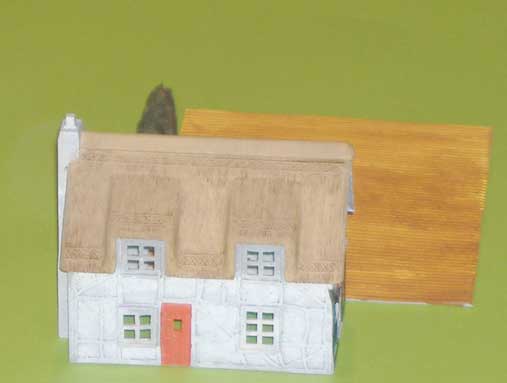
I really like this shade of green - it has quite a nicely artificial look to it that should go well with the rest of the terrain. That blurry little cottage in the background is by Dapol and needs it's paint-job completing.

I'll start work on the bridge this weekend and cut the path of the River Blast.

Wednesday, March 29, 2006

A Few More Thoughts on Fortresses

With the basic shapes already created and with the easy-to-work-with nature of the materials, one could get quite elaborate with your fortress.

Consider this: If you have two demi-bastions, a bastion and two curtain walls, you have the makings of a crown-work. Two bastions and a curtain on their own make an acceptable horn-work, as well. These structures served to enclose detached suburbs, or extend the work deep into the countryside if needed.

Another feature that catches my eye would be to build a 'cavalier' or elevated battery inside a bastion, although I think I might have to re-build my bastions on a rather roomier basis.

Dressing the Polystyrene

I'm at the slow bit now. I've clad the tops of all the polystyrene slabs with heavy card to give a nice flat surface to glue the parapets onto. I'm also going about cladding them in card "stone blocks". This is the really slow bit.

At the moment I'm working at the rate of getting one-and-a-bit slabs clad a day.

Pictures to follow soon.

Sunday, March 26, 2006

More Fortress than you could shake a stick at.


The basic structure is now complete but for two more ravelins.

I'm starting to think about doing a glacis. I could do it with a 15-20mm slab of polystyrene, not too wide, carved at a shallow angle. Where the pieces would meet could be done by 'eye' I think. Line the inside with bamboo skewers to make the palisade and that'd be about it.

Saturday, March 25, 2006

Fortress


This represents about two hours' work with stencils, white glue and hot wire cutter.

To round the basics out, I want to do another wall and another with a gateway. Additionally, I'll also do another two half-bastions to butt up against the table edges. Then I'll probably need two more ravelins.

For fun I'll do another wall, a ravelin and a bastion that have been breached.

Then there's the bridge I'll have to do to link one of the ravelins to the gate.

They'll all need parapets. I'll probably cut them from foam-core card as simple vertical parapets. The real things were very thick, with gun-ports cut in them, but in this scale I don't think it will matter too much. Besides, foam-core is a little too inarticulate a material to take that kind of detail, sadly.

Note the tree on one of the bastions. They used to grow them there so the roots would bind the earthern fabric of the bastion more closely together. Furthermore, the wood would furnish both fuel and the materials from which gun carriages could be manufactured.

Friday, March 24, 2006

Bastion

I bought a hot wire cutter today and used it to trim up some of my polystyrene hills for Blasthof. It was a novel experience, and one I haven't had since primary school.

Having been pondering fortress construction for a good few years I was amazed to turn out an entire bastion in about 30 minutes with the aid of a couple of templates.

I'll do another tomorrow and a ravelin as well.

My hot wire cutter is my best new friend.

Thursday, March 23, 2006

Terrain for Blasthof

Here's a few early thoughts on terrain for the battle of Blasthof Heath.

The ground and the river will be green paper and blue cellophane held down with double-sided sticky-tape.

The plough will be corrugated cardboard covered patchily with sand and PVA and painted brown.

Blasthof Farm will be a Dapol thatched cotage I own.

The Blasthof Berg will simply be two pieces of polystyrence cut with a hot wire cutter an painted the same shade of green as the paper.

The bridge will probably be foamcore and card, painted to simulate stone.

For trees I have a few Merit items. From the same purchase I also have a few fence-lengths and a couple of hedges that will mark the edges of the plough and the farm-yard.

I'll mark the fordable area of the river with brown paper to represent the muddy bank.

Wednesday, March 22, 2006

Some Organisational notes for Blasthof.

My "standard" regiments consist of 43 figures.

There are four eight-figure "fusilier" companies, and one eight-figure "grenadier" company. There are two ensigns and a mounted colonel.

What's the problem? I hear you cry.

Each company is either six or seven privates with either an officer/NCO or an officer/NCO and a drummer to round the company out to eight figures.

All of my grenadier companies are manned by grenadiers in their distinctive headware.

Even for the 32 figure unit, I am going to pull up short by a half-dozen figures when it comes to organising them*. Time to get painting again!

I'm sure I have some RSM 95 castings floating about somewhere.

*Fortunately they are singly-based, so re-arranging my units won't cause any major headaches.

Blasthof Heath

Tuesday, March 21, 2006

CHARGE! - The Basic Rules

For those of us who may not have the book:

The Move consists of five phases:

  1. Movement

Normal

Hills

Woods

Marshes

Obstacles

Cavalry

12

6

6

Na

6

Infantry

6

3

3

3

3

Artillery

6

3

Na

Na

3

    • N.B. All carriages, pontoons &c move at infantry speed.
    • Woods: Guns cannot pass through woods; cavalry can only move through them in single file; infantry can only move at half speed.
    • Marshes: These are impassable to cavalry and guns. May be impassable to infantry or passable at half speed only.

.

  1. Firing
    1. Artillery

i. The gun must be manned by at least 4 soldiers. The target must be visible from the gun and not more than 45° left or right of the direction in which the gun is pointing. The path of the shell or round-shot must not be closer than one inch to any other troops of the same army.

ii. If these conditions are met, measure range to target, then throw dice:

Range to Target&Dice Score to Hit

3’ ****************** 6

2’6” **************** 5

2’ ****************** 4

1’6” **************** 3

1’ ****************** 2

6” ****************** Automatic Hit

iii. If the target is hit, throw dice to decide the ‘standard’ number of casualties. If the range is more than nine inches, the number on the dice is halved to give the standard number; if nine inches or less, the number on the dice is the standard number.

    1. Infantry fire

i. Target must be visible to firer, not more than 45° to right or left, and lines of fire must not pass closer than one inch to own side.

ii. Long range (3” to 6”) - throw one dice per 8 infantrymen capable of firing. The number on each dice is halved for the standard number of casualties.

iii. Short range (0 to 3”) - throw one dice per eight infantrymen as above, but the number on each dice is the standard number of casualties.

iv. A dice can be thrown for not less than 4 infantrymen. The number on the dice is then halved, and should be halved again if the fire is at long range.

v. Infantry receiving fire can count their casualties when returning that particular fire, casualties must then be immediately removed.

  1. Casualties
    1. A fraction of a casualty is disregarded if it is less than half. If the fraction is half or more it counts as a casualty. All firing must be completed and all fractions added together before casualties for fractions can be claimed.
    2. Rates: Infantry in the open suffer standard number of casualties. Gunners and cavalry half the standard number.
    3. Cover: Number of casualties for troops behind cover is halved.
    4. Allocation: Men within range of firing should be decided, and the obvious men made casualties. If there is doubt or disagreement, throw a dice and take appropriate men, counting right hand man as No. 1; If a three is thrown on dice take every third man, until the correct number of casualties has been removed.

i. If a gun crew is the target, a 6 on the dice destroys the gun. Otherwise the man behind the gun is No. 1 and you continue counting clockwise until all casualties have been removed. Guns can only be destroyed by fire from an opposing gun.

ii. Infantry or gunners returning fire next turn can count their casualties as effective for purposes of returning fire only. Such casualties must then be immediately removed.

  1. Melees
    1. These take two turns. First the attacker moves his troops into contact with those of the defender. Next turn the defender can fire (if he is able to). Then after casualties from the firing have been removed the melee is treated as a series of individual hand-to-hand combats. Opponents throw dice against each other and the one throwing the higher number by more than one ‘pip’ wins, the loser removing his soldier from the board. If the combat is two against one or a cavalryman against an infantryman, the player with the two men or the cavalryman doubles the value of his throw. Odds cannot be greater than two-to-one. If neither side wins the throw, both soldiers survive. If a cavalryman and an infantryman fight a single cavalryman, the player with the cavalryman and an infantryman adds a quarter to the number he throws. If the cavalryman and the infantryman are defeated the cavalryman is removed but the infantryman survives.
    2. After each combat the survivor(s) move back 3” if infantry or 6” if cavalry.

  1. Morale

If more than half the original number of soldiers in an army have been removed from the board as casualties, that army has been defeated and can fight no more.
Sunday, March 19, 2006

Hints...

The Red force has:
A General with an ADC;
12 Dragoons;
An Officer of Dragoons
40 Infantry;
Three Officers of Infantry;
2 Guns;
10 Gunners and;
An Officer of Artillery.

Friday, March 17, 2006

Mystery Map...


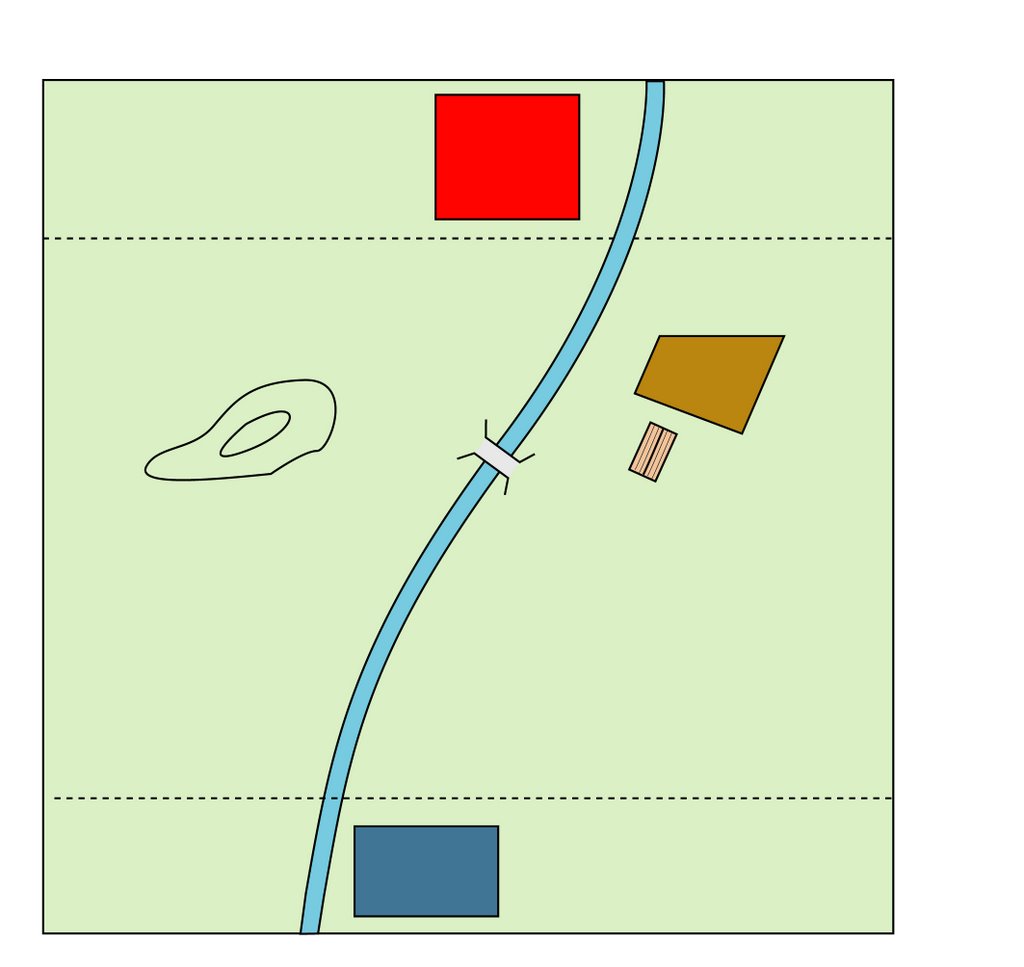
Brownie Points to anyone who can guess which battle was once fought out over this map.

Wednesday, March 08, 2006

HE Miniatures

I just ordered about 10 sample Holger Ericsson cavalry from Peter Johnstone of Spencer Smith miniatures in the UK.

www.spencersmithminiatures.co.uk/

I'm really looking forward to these - especially after I saw Phil Olleys splendid 30-man "Chevaliers de Rouen":

www.warcabinet.pwp.blueyonder.co.uk/Chevaliers_de_Rouen_1.jpg

I am inspired to do some of these HUGE cavalry units. I may have to re-read "Charge!" again.

Battlegames Magazine

The first issue comes out on 14 March. With names like Charles S Grant, Don Featherstone, Stuart Asquith, Bill Protz, James Purky and Mike Siggins himself writing for Battlegames quality is bound to be high.

Go to the Battlegames site and get yourself a subscription.

www.battlegames.co.uk

Tuesday, March 07, 2006

A Little Light on the Dark Ages of the Duchy

Some time ago (either in the Hyborean Age or somewhere around AD500) the Duchy of Alzheim entered a Dark Age. ..

In those days there were oceans of light and cities in the skies and wild flying beasts of bronze. There were herds of crimson cattle that roared and were taller than castles. There were shrill, viridian things that haunted bleak rivers.

It was a rich time and a dark time. *

It was a time when hard-riding men drove their steeds over the grassy plateaux of the Marches of Alzheim and strove to defend it's borders and towering fortresses. These were evil days when the Riders of Alzheim contemplated their own overthrow at the hands of an implacable hate.

This was a time when strange beings stirred in the darkest and most ancient of the forests. A time when a nameless evil walked the land by night and summonned all manner of foulness from the lowlands.

Tapestries and illustrated manuscripts to follow...

*A time for profound apologies to Mr Moorcock.

Sunday, March 05, 2006

New recruits


This way to the car-park, lads.

Friday, March 03, 2006

Batch painting Saxons... again

Alright... maybe tomorrow (walks off muttering...)

Thursday, March 02, 2006

Batch Painting Saxons

I'll be batch painting four Saxon Infantry tonight - Pictures to follow this evening. I'll let you know how I go...

Too Many Officers?

On the Old School Yahoo Group last week there was a discussion of an Old School Author's rules and their seeming over-indulgence in the officer class. This got me thinking.

What on earth would you do with all these fellows?

Here's what I came up with:

* a unit with less than a certain number of officers and NCOs is
obviously unable to adequately supervise the men. Should the Regiment
fall below this figure then it will lose men (deserted, sexually
harassing a barmaid, skiving off for a fag &c) equal to the number of
missing officers per move.

* the gilded staff. Every brigade needs a Brigadier and a couple of
ADCs or messengers. Every Brigadier needs a General to report to. The
general needs a staff and ADCs/messengers. The General needs a
squadron of fancifully-dressed cavalry as a bodyguard. Use the
messengers and ADCs to transmit orders from the general. Units
without fresh orders must conform to the last instruction they were
given...

Failing that, give them to me. I can make a home for them.

Tuesday, February 28, 2006

A Couple of New Recruits


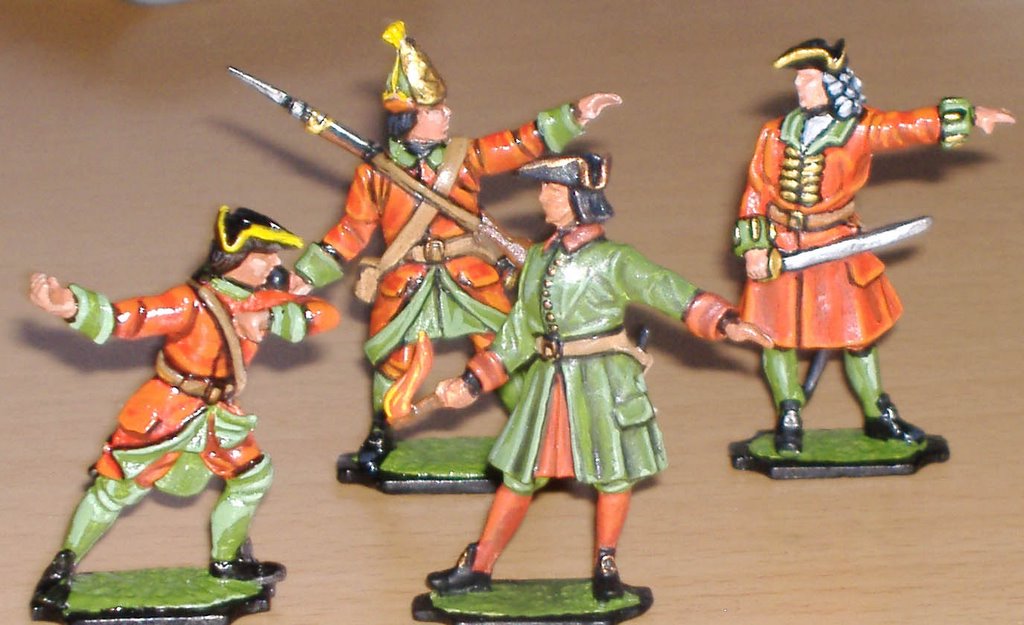
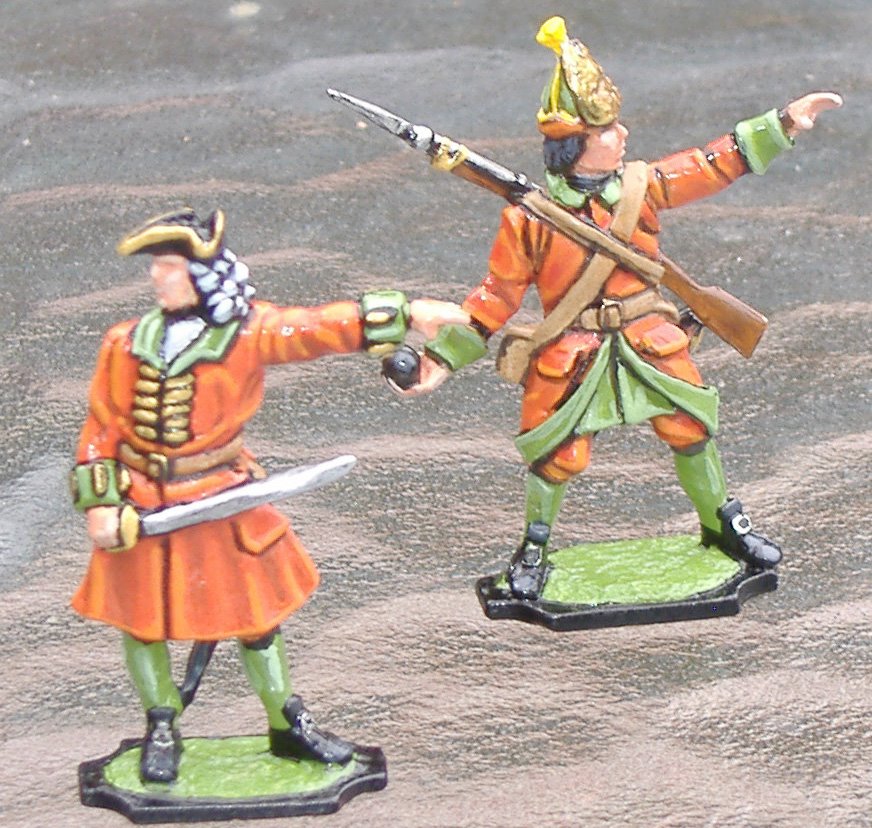
The pikeman (left foreground) still needs his pike of course.

The mould that produced the Gunner in the green coat was an absolute bugger to cast. I think I had to try about something like eight times, and vent the mould in about four places to get it starting to work satisfactorily! Anyone got any hints or tips they'd like to share?

I think he looks nice now, though...

Can anyone tell me when the Saxon Army abandoned the pike in favour of the bayonet?

A Bit of Fun

I have to say that I've been finding painting up my Prince August semi-round miniatures a lot of fun.

Just the fact that I can go and cast up another few whenever I want is liberating in a way that I never really thought of before. I'm a lot braver in how I paint them - I always was wary of painting the larger-scale miniature. I thought my painting technique might not be up to it, and I could never bring myself to ruin an expensive miniature. With these I feel as though if I want another all I have to do is melt doewn some tyre weights, sinkers and GW miniatures and I can bang out another few of what I want! It's a good feeling. It's hard on the poor old tyre weights, though.
You may have noticed that I am painting them up in uniforms more-or-less modelled on those of the Saxon Army up until about 1739. I found a German-language book on the army of August the Strong that I bought a few years ago and which covers everything I think I could need to paint up a few regiments and some gunners. I feel the Prince August moulds are better off depicting armies from the earlier part of the 18th Century (especially the HE ones) and so therefore the red-coated Saxons.

Sunday, February 26, 2006

More DoA Troops c.1720-30


Infanterieregiment du Cailer, Offizier und Mann.

OK, I'd thought of calling them Garnisons-Regiment Mauerscheisser, but that'd just be unpleasant.

Light infantry


British (erm, "Englandian") Light Infantry from the French and Indian War... Just waiting for the right project to employ them...

RSM Light Dragoons


I read about the Battle of Emsdorf in my Blandford on the Seven Years War. I thought wow! this would make a nice little self-contained project. This is as far as it got...

The Grand Illusion


Rather a lantern-jaw, I'm sure you'd agree.

Saturday, February 25, 2006

"Historical" Miniature


I was inspired recently to get my hands on some of the Prince August moulds by the work of Steve Cady, fellow member of the OSW group and a masterful painter. Just today I finally have plucked up the courage to paint my first ever semi-round miniature.

I decided he would be from the Duchy of Alzheim in the 1720s or 30s, a relatively little-known period of the Duchys' past when her soldiers were still wearing the Red coat they abandoned in 1740 for the White. This change probably reflected the internal politics of the State at this time and the predominance of the "French" party over that of the "Saxon" at court.

The bold young infantry officer depicted here (from information taken from the portrait showing him at the time of the War of the Poltroonian Succession) is the Graf von Eisenessen* perhaps better known later as the Marquis de Soubre-Whelm from the title awarded him by a young Louis XV for his actions at the breach at the Seige of Protzhydenlohe. As close students of Alzenheimer history will be aware this was the one major action the men of Alzheim took part in, and this was trying enough to wear the heart out of the army. It is said that the Officers' mess bills for Champagne were enough that they took only a minor part in the better known War of the Austrian Succession.

*Not a relation of Trinksblut und Eisenessen as related by Colonel Grant (99th) in his "What a Game We Make of War" - London 1767.

Thursday, February 16, 2006

New Link

Take a quick voyage over to the Seas of Fate - a page I'm putting together to hold my fantasy-related materials.

Tuesday, February 07, 2006

New link - Colonial Capers

Take a look at the "Colonial Capers" link in the links section on the right of this page. It's a shortcut to my Colonial wargames blog. Just starting up, but there are a good few posts (mostly pretty pictures for now, but there is a battle-report) worth taking a look at (I hope!) - see you there!

Monday, February 06, 2006

Upcoming battle report.

Things are quiet here. Too quiet...

Is that a rustling in the woods over there?

Perhaps...

I think we might send the light infantry to take a look.

This weekend coming, I will do a small battle between the light infantry forces of Englandia and the GSH Duchy of Soubre-Whelm. I think some nice pictures will be in order.

Who wants to suggest a scenario? I'm thinking about 20 figures to a side - perhaps 15 Infantry and 4 or 5 Cavalry. Objectives? A missing Vivandiere? A misplaced barel of spirits? Rival groups of foragers?

Let me know.

Another little project?

Maybe. I've just won a small lot of "Merit" model railway accessories on eBay, including a nice little collection of trees.

I note that they are the same trees that Mr CS Grant used in his wargaming setup.

Perhaps I could start doing some "lift-off" balsa buildings?

Tuesday, January 24, 2006

For Alte Fritz 1740!


Just to show you the Gardes Francaises are not wholly asleep and continue slowly to be added to!

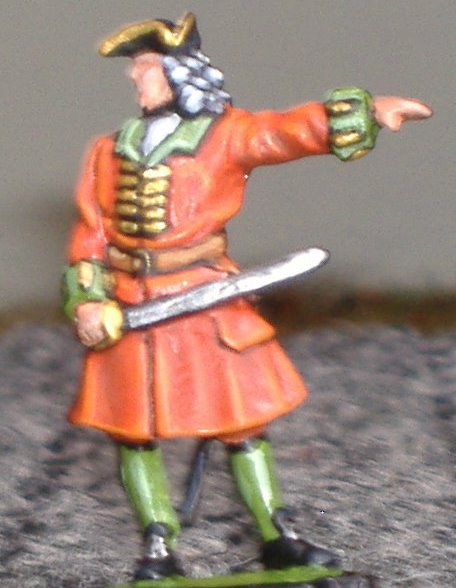
I've some few Surens I'm wanting to use up, and what better regiment of foot to use them up on - the rank and file are RSM while the officers and NCOs will be these fine felows. One of my earliest posts shows another couple of officers whose coats need re-painting in this chap's manner.

Turpin Hussards en Masse


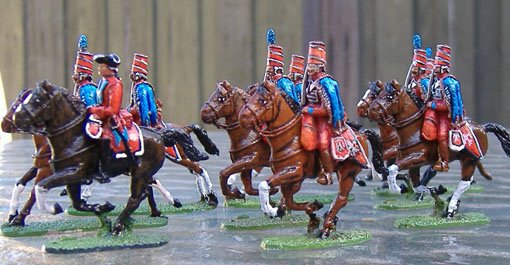
The Turpin Hussars are now getting along nicely - at half strength now, and slowly increasing.

Hussard des Volontaires de St Victor


Just a little test figure for the first of a French (err, the Grand High Supreme Duchy of Soubre-Whelm) Light Corps to counter that of the shifty von Kleist. Looks like he's crossing a frozen lake (un lac glacee? Probably not..!). Now that's a piece of useful wargames terrain!

Quelle un deus ex machina!

Wednesday, January 18, 2006

A few thoughts on building Hussar Regiments and Light Corps

I'm cleaning up the first few castings of the box of RSM Hussars I received from DPC in the US the other day. They are really nice. The castings are very clean, very crisp, almost flash free and with only a few points on them from casting vent channels.

Their designer, the late Steve Hezzlewood was a giant among sculptors and I wish that other manufactuers would take many leaves from his book. Preferably, they might just take the whole book!

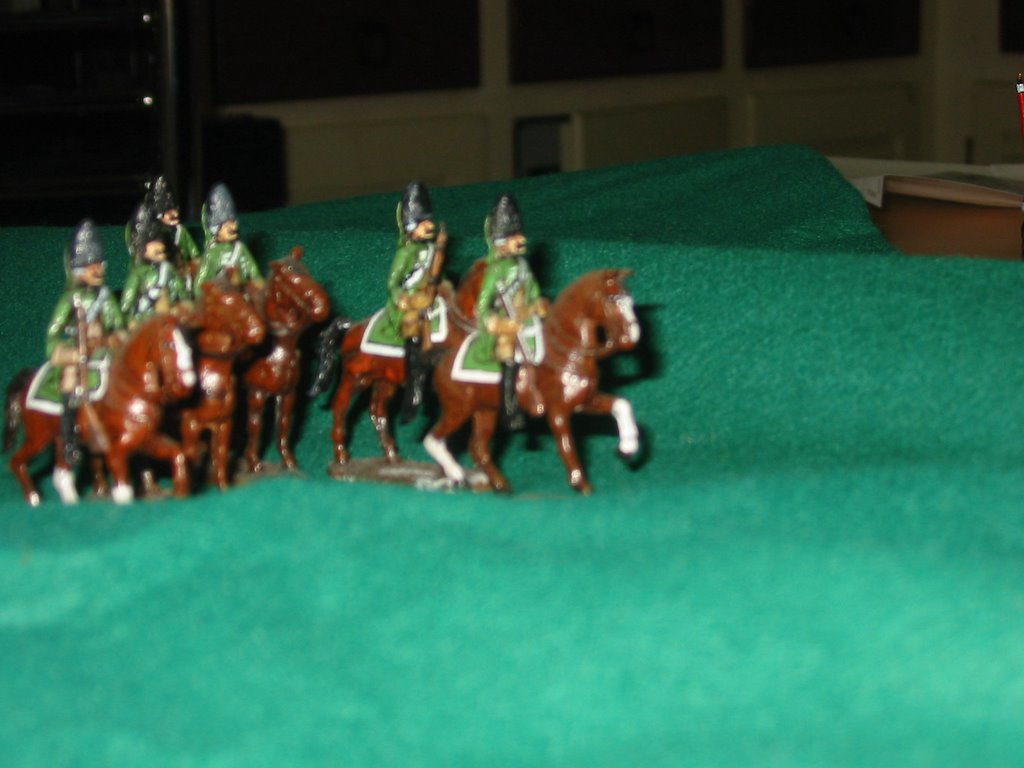
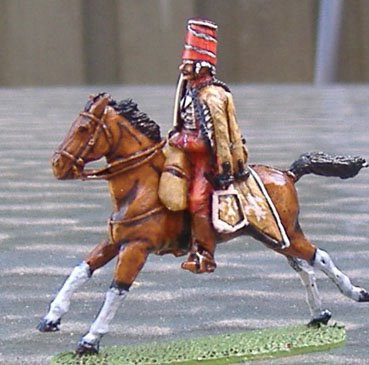
These are the Prussian Hussars in the Mirliton with an additional Austrian one in the fur Busby/Colpak to serve as an officer (according to my references the Turpin Hussars' Officers were so attired). I've a Line Trumpeter in tricorne and the coat with the hanging sleeves as the musician - his uniform is reasonably accurate as to my sources. I've no idea what their standarf-bearers wore and as RSM never did a standard-bearer for the Hussars, I'll be using a Line Cavalry trooper with a flagstaff in place of his sword. I wouldn't do this to one of the Hussar troopers as the conversion would require major surgery.

Having ordered, I've found myself with a figure or three over from my new cavalry establishment (two officers, a guidon, a musician and two squadrons of eight troopers) of twenty figures.

This led me to start flipping through my Ospreys for inspiration.

I discovered a light corps called the "Volontaires de Saint-Victor" with a charming Hussar uniform of red laced white with a buff pelisse and shabraque. As we know, many of the light corps raised by France were composite units incorporating infantry, cavalry, and, in some cases, artillery!

The "Volontaires de Saint-Victor" were no different in this respect, incorporating eight companies of hussars, eight of fusiliers and one of grenadiers. The infantry wore a blue coat and collar lined and turned up in red with white small-clothes, buttons and hat lace.

I thought it might be worth raising a couple of companies of hussars and a couple more of fusiliers. I do wonder though at their role on the tabletop, though. I mean I can see that you might use the infantry as skirmishers, but the cavalry?

I suppose I could brigade them with the Turpin Hussars. If nothing else, I suppose I could use them in a small skirmish battle of foragers versus foragers, or in a scenario involving scouting forces. I guess I see their role as being more operational rather than tactical and am having trouble getting my head around their tactical role.

Monday, January 16, 2006

Duchy of Alzheim indeed! Choices to make.

I forgot that I made an order with DPC for some more RSM miniatures before Christmas.

I got the reminder today when they arrived in the mail.

Now I've enough Hussars to finish off the much-delayed Turpin Regiment!

Huzzah!

Now I just have to decide how far the Wurttembourg Regiment gets bumped in the schedule.

Alte Fritz wants me to get on with the Gardes Francaises, too.

Thursday, January 12, 2006

Peacock exposed!


Brigadier the Marquis Creosote Force-Majeur reviews some rather drab grenadiers who fade into the background in the glare of his splendour.

Wednesday, January 11, 2006

The Duchy of Alzheim: Temptation

The Duchy of Alzheim: Temptation

Temptation

Temptation is a dreadful thing.

A new OSW member has posted the following link to his featured work on the Prince August web site.

http://www.princeaugust.ie/steve_cady/index.html

I still own some of the 24mm Napoleonic moulds I got one Christmas as a child.

I am starting to dream of a 40mm "big battalion" project to work with some rules I've rediscovered.

Most of the moulds are about 10 euro each. They are good for HUNDREDS of uses.

Someone help me, please.

Tuesday, January 10, 2006

Quaint note

The instructions for that Historex Kit reference the Funckens' "Guerres en Dentelles" as a uniform guide.

And now for something a little different.


Just recently I was fortunate to acquire a superb Historex kit of a French Infantryman of the 1750s. Something of a departure from their more usual Napoleonic fare, the painting instructions are bu Eugene Leliepvre and worth the asking price on their own! They are simply gorgeous and I'm sure they will wind up framed on my "war room" wall.

Take a look at that. Eye candy or what?

Monday, January 09, 2006

A win, I think. I hope!

Abe Books. We all know and love Abe Books. That's where we get our pricey old Blandfords and Pengel and Hurts and copies of Charge!

Some months ago, I found a copy of Charles Grant's "The War Game" going there at the right price and put in my order.

Sadly, unbenownst to me and the poor vendor, an Abe-glitch truncated my address and to him it looked like a PO Box.

Good news, however; the dead letter office did a "return to sender" and my nice vendor is going to try again with the correct address!

Wish me luck.

Friday, January 06, 2006

Battlegames Award for Excellence


I am very pleased and proud to announce that this blog has been awarded the Battlegames Award for Excellence. My thanks go to Henry Hyde of Battlegames. Please take a moment to visit his excellent website - see the links section to get there.

Tuesday, January 03, 2006

1000 Hits on this Blog

Wow - and thanks to everyone who has come to see what's ticking away here at the Duchy! Happy 2006 to us all!

Monday, January 02, 2006

Tuesday, December 20, 2005

New Unit Completed

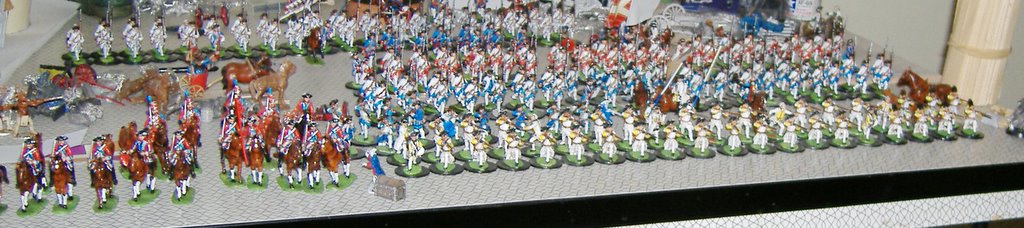
Regiment Bourbonnois has been completed.

That takes me up to four French infantry regiments.

I'm also grinding slowly away at the Gardes Francaises a couple of figures at a go. For fun I'm going to paint up one of their drummers in the Grand Livery lace. I've also done a minor conversion on the French "NCO" with his hat off available from RSM to turn him into the obligatory "bowing officer of the Gardes Francaises inviting the British to fire first" pose...

Friday, December 16, 2005

Slackness admitted!

I have been slack. It's been ages since I've posted. Mea culpa.

It's Christmas. Real life has been inserting it's boring self and getting in the way of my proper business!

I have finally just finished of Regiment Bourbonnois, and really feel that I have a decent-sized force at last. It's gotten me ready to do Cavalry Reg't Wurttembourg.

My last report has convinced me to go with larger cavalry regiments, so I will be building to 16-18 figure regiments of horse from now on - as well as going back over those I have and beefing them up. Following Wurttembourg, I think I will be adding another Squadron to my Turpin Hussars. This will give me a respectable three regiments of Horse to go with my four of Foot.

I think then it will be time for me to paint some gunners.