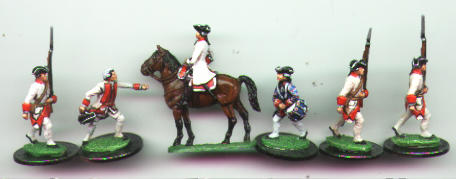
Saturday, October 15, 2005

Wee Highland Laddies Part 2


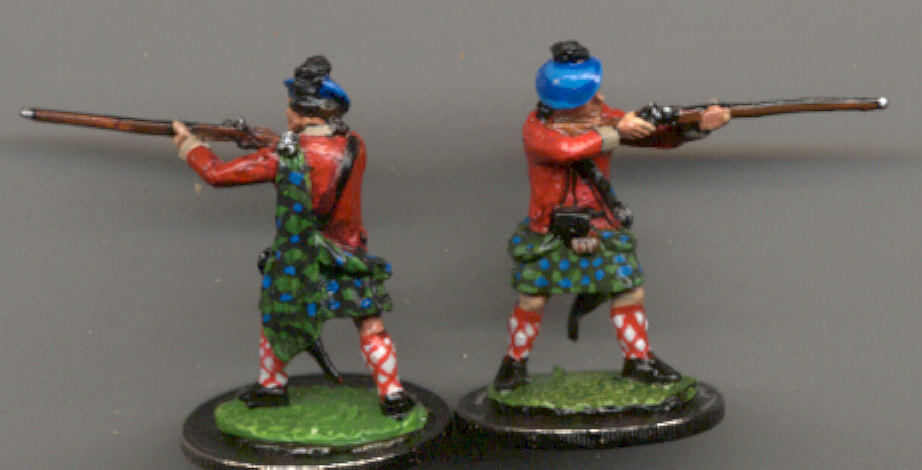
You ought to be able to click on this image to get a larger version...

Friday, October 14, 2005

Wee Highland Laddies

In the past couple of weeks I have taken delivery of a second-hand, ex-library copy of Charles Grants "The Battle of Fontenoy". Thank-you Bookfinder.com.

I also have to admit to a slow and growing bias toward structuring my Armies after those that fought this battle.

These factors, along with my own long-standing interest in the French and Indian War has led me to believe that a unit or two of Highlanders are absolutely indispensible to my collection.

I have plucked up the courage to start painting some Highlanders.

Courage? I hear you ask. Why yes, I reply. Highlanders are famously intimidating for more than just their reckless charges with the Claymore.

It's the tartan.

How do you paint it? It's so complicated! I know, I've tried.

My first experiment was with the Royal Stuart Sett (this is a technical term that means "pattern" as far as I am concerned) that looked like someone had been ill on a pizza. Yuk.

My references have pointed me at two regiments for the periods/theatres I'm interested in. My Blanford "Uniforms of the Seven Years War" has men of the 42nd and 78th regiments, both in a dark green tartan with black or very dark green overstriping. Figure 133 is a grenadier in a fur cap that would have not been out of place in the AWI. His sett has a red "overstripe" (ie, a thin, sparse, red stripe over the larger pattern of the sett) in addition to the basic "Government" tartan. Apparrently this was an additional mark of his status as a grenadier. Alan Saphersons' "A Basic Guide to Armies and Uniforms of the Seven Years War" is in complete agreement. My Osprey MAA-285 "King George's Army 1740-93: (1) Infantry" offers on plate A3 an alternative in the form of the short-lived 64th Highlanders who should have had the same sett as the 78th or 42nd, but may also have had a red tartan of the kind you might see on a tin of short-bread. Maa 48, "Wolfe's Army" likewise ascribes the red sett to the 78th, but this is conjectural according to the notes on the plate.

Based on all this I am most definitely doing the 42nd Regiment in their green sett and buff facings. I am also thinking very hard about doing the 78th who could double up as the 64th at Culloden - both seem to have had white facings. Whether I do them in the green or red sett is another thing. I like the red sett as a point of difference from most other Highland units, but feel that the darker tartan stands ou better against the red doublets.

So, on to painting the Tartan.

I prime my figures white and then paint all the flesh areas in their base colour and follow that with a thin was of sepia ink. This includes the knobbly knees.

I give the kilt and plaid a thinnish coating of a nice mid-green. In my case this is Vallejo "Goblin Green". Because it is slightly thinned down, it shades and highlights itself enough without being heavy handed. I then over-paint a grid of dark stripes with a mix of 50:50 black and green with no more than three horizontal stripes and a vertical every 2-3mm.

When dry I mix up a lightish blue (whatever looks good to you) and paint a little square wherever the dark lines intersect on a flat or raised part of the kilt or plaid. Likewise, I mix a 50:50 white and green and apply it to the raised or flat parts of the kilt/plaid - this is also a good opportunity to do a little cutting in on the grid lines - these are never steady or even and can always do with some tidying up.

The hose are very simple. Starting with the white undercoat, paint 4-5 clockwise spirals down the leg, eack reaching abour half the circumference of the limb. Do this first clockwise then anti-clockwise. Paint a circle of red around the top of the hose, a black shoe at the bottom, then cut in with white where coffee has caused your brush to err!

I'll post a pic in a day or so to demonstrate all this palaver.

As for the red sett, give me time to nut it out. I suppse the key here is to give the impression of Tartan while not driving oneself insane.

Sunday, October 09, 2005

What I did on my Holiday...

I have been on leave from work this week. My reason for this was to get my back yard finished off.

I also managed to get some painting in. Cavalry Regiment "La Reine" now graces my table, much to my delight. My French army is starting to get a bit decent - three regiments of infantry, a regiment of cavalry and a battery of Artillery (not counting the squadron of Turpin Hussars and a half-regiment of the Compagnies Franches de la Marine...).

I also painted up a company of French infantry as a test for doing the all-white Bourbonnois regiment. I think they look pretty nice, so on I go.

Does anyone know whether the Bourbonnois Regiment's Grenadiers wore bearskins by the later part of the Seven Years' War?

Thursday, September 29, 2005

Some thoughts on Cavalry in Melees

These are a first draft on how I think Cavalry melees might run and were prompted by a discussion running on the OSW Yahoo Group:

Against Cavalry:
* Side 'A' - Declares Charge
* Side 'B' - Tests morale to see if they will either flee (1,2 on a d6?), standto receive the charge (3, 4, 5 on a d6) or counter-charge (6 on a d6).
* Side 'A' - Charges home then both sides melee.

The melee itself is difficult.

Should Side 'B' be fleeing, I think Side 'A' should be allowed to overrun into them on the same move and then melee at a very great advantage.

Should Side 'B' stand to receive the charge, I think they should perhaps melee on even terms just because I can't imagine Side 'A' smashing headlong into them and I do feel they would come to a halt in the face of this steely resolve.

In the case of Sides 'A' and 'B' both charging hell-for-leather at each other,I'd throw a d6 for each figure, perhaps removing a casualty on a '6' to represent collisions. I'd also have them "pass through" each other to the maximum extent of their charge moves. As the figures interpenetrate, I'd like to come up with a means of representing them taking a wild cut at each other.Wounds might result, but 'kills' would be rare.

I'd want to make this last case (hell-for leather mutual charging) the least likely outcome, with perhaps the second case being the most likely, followed bythe first in order of probability.

Against Infantry:
* Side 'A' - Declares Charge
* Side 'B' - Tests morale to see if they will either flee (1 on a d6?), stand toreceive the charge (2, 3, 4, 5 on a d6) or counter-charge (6 on a d6).
* Side 'A' - Charges home

In the case of the Infantry standing to receive the charge, I think there will be no melee, just a bunch of cavalry standing in front of the Infantry engaging in a musketry duel, at terrible disadvantage. If the Infantry run away, or aredisordered or are skirmishers in open order, the cavalry should be allowed tocontact them where they will melee against them at very great advantage.

I think the Infantry should be allowed a volley as the cavalry close, however.This however makes me wonder if the Cavalry might not have to test morale to close to hand-to-hand combat.

In the case of the infantry choosing to counter charge, well, my mind boggles abit here because I can't recall any historical examples, so I'm tempted to discount the option altogether. I'd be tempted to fold that possibility in withstanding to receive the charge.

The trick with all this is to see how it might fit into a "Move, Fire, Melee,Morale" turn framework, of course. It's at times like this I start thumbing through my copy of the Sword and the Flame for ideas to emulate!

Monday, September 26, 2005

Painting Horses

I painted 17 horses over the weekend. Here's how:
  1. Clean up the castings
  2. Prime white. Cheap spray-paint works for me. It MUST be matt to give your nice paints something to grab onto. Nothing is worse than watching your paint "bead" on a surface you are trying to cover.
  3. Basecoat the horse. A nice warm brown. Don't apply the colour too thickly. It looks best with the undercoat "lighting" the colour from beneath.
  4. Apply a thinned wash of sepia ink to the whole miniature.
  5. Allow it to dry for at least a couple of hours.
  6. Mix up some orange with your base-coat colour. Go for a 2:1 ratio - in the oranges' favour. Wet-brush it all over the model working from top to bottom. As with the uniforms, the idea is to make it look as though the figure is being lit from above.
  7. After that's dried, give the whole model a "damp-brush" of almost pure orange. Don't be afraid to leave patches of pure colour.
  8. Apply a second wash of thinned ink. This will pull back your worst excesses with the orange paint.
  9. Allow it to dry for at least a couple of hours. Mow the lawn. Watch some telly. Read the newspaper.
  10. Get out your black and paint the eyes, manes, tails, hooves and any part of the leg you want to do with white "stockings", as well as any area on the horses' forehead that needs a "blaze". Similarly, every time the brush is running a little dry, dip it in your pot of water and paint fine lines wherever you want to define the edges of harness, muscles &c.
  11. Get out your white paint. Paint the "stockings" and "blazes". When your hands are really steady, put a miniscule point of white in each corner of the eyes, leaving most of the area in the original black.

One additional point is that slightly thinned paint that flows evenly is preferable than thickish paint that covers well. I would much rather give an area an extra coat than have my paint blob or cover a detail I was trying to paint. Make your paint about the consistency of milk and you can't go too far wrong.

Friday, September 23, 2005

Grenadiers - Gardes Suisses and Francaises.


Another couple of samples.

Regiment Guyenne


This is a taste of what my newly-finished regiment looks like.

Turpin Hussars


Nothing new here - just a better picture to atone for my lousy digital photograpy.

Thursday, September 22, 2005

Progress!

Today should see me just about finishing off a new unit, the regiment Guyenne.

This morning I put the finishing touches on the second last tranche of figures, and I intend to do the last lot tonight.

Flags are by Warflag, correctly-sized, freshly-printed and ready to be mounted on their brass wire flag staffs.

I'm in the golden glow stage at the moment and am really looking forward to just lining them up on my painting-table at home and seeing how they look with their comrades all in formation with them!

For a change of pace, I am going to do a regiment of cavalry. I paint horses fairly quickly, so the work should progress quite well.

Friday, September 16, 2005

Painting

With my French I paint pretty simply.

I take the largest single area of colour (WHITE!) and do the whole figure over in a slightly darker version of it. This involves adding about 5% of a pale brown to my white and just making sure the whole figure is thoroughly covered.

Once dry, I lightly load a brush with pure white and brush roughly down the whole length of the figure working from top to bottom. This has the effect of putting the lightest "colour" on top of the figure while leaving the recessed areas darker.

Now I do all the other bits of colour - facings, flesh, hats, hair, belts, boots, buckles and braces.

Flesh areas get a thin wash of brown ink followed by a highlighting of a paler shade of flesh.

Hair, which has been painted over in black gets touched in with white to represent powdered locks. The lower lip might get a tiny dash of red ink. The occasional moustache might get a couple of dashes of white over the black base to denote a veteran.

All other colours are left unhighlighted.

Lastly, I slightly thin some white to a milky consistency and use it to paint areas like the tops of shoulders to finish the highlighting. This is also a good opportunity to cover up the inevitable mistakes I make when applying all the other colours.

For a figure with a different main colour (say the Gardes Suisses with their red coats), I do a base coat in the main colour, wash that over with my sepia brown ink. Wait for a few hours while that dries and then heavily "wet'brush" it with the main colour again to restore the brightness.

This is how the Gardes Suisses test figures further down this page were painted.

Thursday, September 15, 2005

What's on the Workbench 2

I should also mention, that after the recent acquisition of a couple of bags of cavalry, that one thing I am going doing is getting cracking on the Gendarmerie de France.

My other bag will become either the Wurtemburg or Nassau-Saarbruck regiment.

At some stage in the (near) future, I would like to do the Conde regiment.

What's on the Workbench?

To ask the question is to provide the answer - quite a bit!

Work goes well on Regiment Bearn - it ought to be finished by this time next week. I'll follow up with a post on how I have been painting my French regiments.

As you all could see from earlier posts, I have finished off the first squadron of the Turpin Hussar Regiment. I had originally thought that I might do the Royal Nassau Regiment, but it turned out I had better sources for Turpins'.

I have figures on order to make a second squadron. By the time this regiment has been pieced together, it will have been done with 10 Prussian Hussars in Mirliton (the troopers), one French Trumpeter and an Austrian Hussar in Busby (representing the CO). It's a pity the trooper figures aren't a little more animated, but there you go!

I reward myself when I am painting a big batch of figures by letting myself paint a handful of more colourful or just "different" troops. For being good and painting up Regiment Bearn, I am letting myself repaint two RSM marching Lorraine Grenadiers (almost the first figures I ever seriously "tried" to paint) as being from the Gardes Suisses and Gardes Francaises. I will post some images when they are done. I hope that they don't raise the bar too high for the rest of their units. Those test figures always seem to get that little bit of extra-loving-care.

My Saxons are still plodding along - two or three figures at a time. I must extract my finger and make a concerted effort on one of the Regiments. I've discovered that the RSM Austrian Freikorps Lacy figure would make a pretty passable von Rochow Fusilier, so there's another project for my Saxon Army - especially considering that there is a Prussian Infantry Officer without lapels who could lead them.

Beyond this, I am expecting a pretty substantial re-inforcement in the form of more RSMs I was fortunate to acquire in a trade. They'll let me add another two or three French regiments and put me in a position to start thinking about which Bavarian and which Hungarian Regiments I might like to go to work on. I like the idea of allying the Bavarians up with the french, it's like the War of the Spanish Succession all over again. It might be fun to put on a scenario with them recreating the storming of the Schellenburg!

I think that'll keep me until Chrismas. 2006.

Saturday, September 10, 2005

Turpin Hussars


I've just finished painting these Hussars from the Turpin Regiment. Figures are RSM. I'll need to buy the Austrian Hussar in the fur Busby to represent an Officer.

The Italian States - 1740 to 1760

I've just joined MagWeb and was very interested to read a number of articles on the armies of the Eighteenth Century Italian States, in particular one on the Papal Army of about 1708/1709.

I posted a query on the various Yahoo Groups dealing with the Eighteenth Century that I'm a member of looking for information on the Papal Army of the 1740s and 1750s - this being more my period - and have had a number of replies, one from a gentleman offering to post me some of the materials he's gathered over the years.

I think doing a brigade from the Papal Army - and maybe one from Genoa or Sicily might make for an interesting diversion. Watch this space; with my correspondents' permission, I'll put some of his information up here.

Thursday, September 01, 2005

This Weeks Quiz Question!

Why was the battle at la Belle Famille fought on July 24, 1759?

Wednesday, August 31, 2005

RSM Figure Conversion
In an earlier post I mentioned converting some Prussian Grenadiers into standard bearers. This follows a tip-off from Alte Fritz on the Old School War Games Yahoo group. The image to the left tells the tale. The first on the left is an unmodified figure, the second has had his musket cut away and his foot cut from the base. The figure on the right has been bent into a more-or-less upright position, with both feet on the base. To me he looks like he is advancing with some caution! Remember always to pad the jaws of your needle-nosed pliers - they cut into the metal if you don't. I recommend masking tape.

Tuesday, August 30, 2005


Saxon Leibgrenadiergarde
New unit begun! The Saxon Leibgrenadiergarde, as usual of RSM figures and coming along nicely - fifteen of them done and with another couple of figures in the mail to convert into standard bearers. I'm quite pleased with how they are going and am taking it slowly - I'm only painting 3-4 figures at a time.

Sunday, August 28, 2005

New Arrivals

At the moment I'm awaiting the arrival of some more RSM miniatures. I'm expecting to take delivery of a couple of bags of French Cavalry, a bag of Prussian infantry and some odds and sods.

The French Cavalry will probably get painted as either something from the Maison du Roi or the Rohan cavalry Regiment for one bag, and one of the German regiments in French service - I am looking at the Nassau-Saarbruck and Wurrtembourg Regiments just now.

The Prussians will go towards the Saxon Graf von Bruhl Infantry regiment (an example of Prussians being impressed into the Saxon service!) and another Prussian Regiment - identity as yet undecided, but I am tending toward that which had it's grenadier battalion paired up with IR 13 'Itzenplitz'. Must read Duffy again.

Among the odds and sods will I hope be some marching Prussian Grenadiers. I was prompted to buy them by a post on the Old School argaming Yahoo Group discussing transforming this figure into a standard-bearer. I mean to give it a go and report back.

Cheers for now...!

One Last Pretty Picture

This is about at good as my painting style gets. It looks good (I think!) but as a style, it's not too sustainable for the hundreds of figures you need to do to create an army of the size demanded by the size of units i like to collect. This figure (a Suren British Grenadier) has been painted to epresent a Hanoverian Grenadier.

Flag in Action
In an earlier post, I put up an image of the colour of the Gardes Francaises. This picture shows what it looks like in "real life".