Right then.
The anal-retentive within calls for an accounting.
The progress of painting (house, not soldiers!) continues, but there is hope that this evening Madam will be out to the football which means I can sneak a few hours painting of a more pleasurable kind in.
This week I've been steadily working on a block of 16 RSM British Infantry and a Stadden British Grenadier NCO. They are all base-coated, flesh painted and have their hat-lace sewn on.
I think I might be able to polish them off tonight - it's really just a matter of getting all the highlights in and painting weapons.
That will see the British Contingent for la Belle Famille completed - in fact completed rather over specification.
The scenario calls for 30 Light infantry. I've painted 31.
I need 10 Line of the 44th - I have 18.
I need 38 Line of the 46th - I'll have 46 painted by this evening.
I need 5 Grenadiers of the 46th - by this evening I ought to have 11.
I need 10 NY Provincial Infantry - I have four. What???
Currently I have a package waiting for me at the post office with (I anticipate) another 16 Provincials and 72 Indians which ought to see me done.
I am over quota on my British. Don't worry! There's a plan to that! I'm just pushing through with an eye on campaigning the siege iteslf. I have been painting artillerymen in infantry uniforms to represent the garrison at Fort Niagara, as well. I ought at some stage start doing the same for the British.
I've mentioned earlier that I already have sufficient French to see me over the line, although they are not really from the right units, historically speaking, so there's no more painting to do on that front, thankfully.
Saturday, April 11, 2009

Sunday, March 29, 2009
The Light Bobs
 I have finally completed the light infantry contingent I need to do the La belle Famille scenario. I've been fitting them in between bouts of plastering and skirting-board laying as we prepare for our coming new arrival*. It's amazing what you can get done in 20-30 minutes while you get ready for work. From the rear they are the Light companies of the 4th/60th, the 46th and the 44th regiments.
Each company is ten figures strong, representing their real-life counterparts at a ratio of 1:5.
 They are being led by Captain de Lancey. The casting is a Prussian Officer, but it's close enough to the look of the British troops that I am comfortable using him.
The figures are by RSM (as ever) with a few minor conversions to turn up the peaks of their cut-down tricornes for a little variety.
I find that I have ten castings left over in the stand-and-fire pose, so I am considering doing Gage's light infantry at some stage in the future.
*Yes. There's a baby on the way. Number One. Ogodogodogod....
Tuesday, March 17, 2009
Alzheim Market Square
UPDATE: They are going onto eBay by 10:00PM AEST today.
A few days ago I got a bit of a rush of blood to the head and kinda, sorta, accidentally bought two boxes of Revell Seven Years War Austrian Dragoons.
Silly me. What can I say?
Would anyone like them before I throw them on eBay? I'm looking for $AU30 for them or equivalent in trade.
http://www.plasticsoldierreview.com/Review.aspx?id=622
All figures are there; mint and still on the sprue.
Any offers? Please contact me at: bloggerator@gmail.com
A few days ago I got a bit of a rush of blood to the head and kinda, sorta, accidentally bought two boxes of Revell Seven Years War Austrian Dragoons.
Silly me. What can I say?
Would anyone like them before I throw them on eBay? I'm looking for $AU30 for them or equivalent in trade.
http://www.plasticsoldierreview.com/Review.aspx?id=622
All figures are there; mint and still on the sprue.
Any offers? Please contact me at: bloggerator@gmail.com
Sunday, March 08, 2009
Fort Niagara Baseboard

It's taken me four hours, but I've finally finished transferring my gridded image of the fort to a 3 foot by 4 foot board of 5mm MDF.
The next step will be to start building up the fort from polystyrene.
UPDATE:
Regular commenter DC wrote to ask about scale for the French Castle and I started rambling. As you would; It's early in the morning here and I've not yet finished my first cup of coffee. I'm dropping my reply here.
I'm going to start off as I did the base-board and look at keeping to a 1"-equals-10-yards standard and see how I go from there.
When I'm building a piece of wargames terrain, I telescope the scale of the object depending on how large ther are in reality.
For example, I recently built three model ships, each of different sizes. The smallest (a Torpedo-boat) was a straight scale model at 1:60, whilst the others kept their 1:60 vertical scale while their length and width were more and more ruthlessly truncated to make them "gameable".
I think by that measure, it depends on what you want the buildings to do. The smaller the scale of the game (ie, skirmish), the larger you want your buildings to be so your little men can interact with them more. In larger games the buildings should become more abstracted, while fewer of them ought to represent more substantial settlements - 4-5 houses can be a town, 7-9 a town and so on.
The French Castle (or machicolated house) will get that sort of treatment and suffer some scale compression on the 'ground', but will still be fairly imposing.
Monday, March 02, 2009
Fort Niagara - to scale
Update: the map. Be warned! It's almost 1MB to download. It is scaled to print out on a piece of A3 paper for those of a bold nature...


As part of the process of creating a model of Fort Niagara, I've asked my ever-obliging partner Amy to help me with scaling out the fort fom the plans reproduced in Dunnigan's "Seige".
I scanned the picture for her and asked her to overlay a grid of squares, each a scale 150' x 150' which is taken from the scale in the map legend at it's upper right corner.
Remembering that Drums of War (among others) uses a ground-scale of 1" to 10 yards, it is simple to calculate that each grid-square will equal 5" x 5" on the board I'll build the fort on.
I will grid the board in 5" squares and then transferring the details will be relatively straigtforward.
I scanned the picture for her and asked her to overlay a grid of squares, each a scale 150' x 150' which is taken from the scale in the map legend at it's upper right corner.
Remembering that Drums of War (among others) uses a ground-scale of 1" to 10 yards, it is simple to calculate that each grid-square will equal 5" x 5" on the board I'll build the fort on.
I will grid the board in 5" squares and then transferring the details will be relatively straigtforward.
Wednesday, February 25, 2009
Gen'l Pridoo's Command. Ye-haa.
 Ye Extant Command of HMB Majesteys' Forces. Ye Soulders herein Numbered bare half those Required to Drub Ye French at la Belle Famille.
 Ye Gen'l Pridoo w'th a Savage of ye Woods. Can dbl as ye Gen'l Braddock at the Late, Lamentable Reverse upon the Monongahela.
 Ye 44th of Foote with ye Remn'nt Grenadoer Cpny. Light Infantery to Ye Fore. As may be seen, can be Used by Amateur Gen'ls Wishing to Re-Create the above Lamentable Reverse with An Eye to Overturning ye Historickal Outcome.
 Grenadoers and ye Line Infantery of HM 46th of Foote.
 Ye Men of Ye Light Company of Ye 60th Reg't of Foot (Ye Royal Americans).
Please note that after writing this post, I was required to have a good lie down with a dictionary and a theaurus.
Fort Little Niagra
I have been researching Fort Little Niagara these past few days with an eye on the goal of building it for my extended Niagara campaign.
There is very little pictorial evidence.
This link points to a reconstruction that is based on the written evidenceso far as I can tell. As can be seen, it’s a “U” shaped stockade terminating on the river with a block-house at each of the corners that face the portage road.
I’m not too sure that the use of block-houses in this representation are accurate, but they are a valid interpretation of the word “bastion” as mentioned in my 1994 edition of Pouchots’ Memoir. Keep in mind though that they could also be interpreted as square projections of the basic ground-plan of the palisade with a firing-step inside with perhaps a stout little cabin as a redoubt within. I'm thinking here of other French Frontier Forts from Chartrands' FORT 75" published by Osprey.
There is very little pictorial evidence.
This link points to a reconstruction that is based on the written evidenceso far as I can tell. As can be seen, it’s a “U” shaped stockade terminating on the river with a block-house at each of the corners that face the portage road.
I’m not too sure that the use of block-houses in this representation are accurate, but they are a valid interpretation of the word “bastion” as mentioned in my 1994 edition of Pouchots’ Memoir. Keep in mind though that they could also be interpreted as square projections of the basic ground-plan of the palisade with a firing-step inside with perhaps a stout little cabin as a redoubt within. I'm thinking here of other French Frontier Forts from Chartrands' FORT 75" published by Osprey.

My alternative interpretation of a "bastion" at Fort Little Niagara.
This next link on a way marking website shows a picture of what is called a barracks chimney built in 1750. If nothing else it was at least as tall today as it was then and would have serviced a building of at least two stories. More than that we cannot tell.
Pouchot describes the site as flat and good for erecting earthworks. I think we could surmise that there were none or minimal works at the site; a ditch and bank at most?
Let the imagining of the fort begin!
UPDATE:
Has anyone got a tip on making palisades? Those bamboo skewers look so much like... bamboo skewers.
Tuesday, February 17, 2009
British Grenadier(s)
 Grenadiers of the 46th Foot, obviously doing a little firing drill as they get ready to meet the French at la Belle Famille.
 I'm getting the hang of painting the British (sheesh, it only took 20 or so figures!) and have evolved a style that is quite pleasing while retaining enough of the heavy lace detailling that I think can be a bit off-putting when approaching them for the first time.
 I've tried fairly hard to differentiate them from the 44th Foot by giving them nice, smart, white gaiters and left them with laced, red waistcoats. Note that they also sport lace "wings" on their coats. These were surprisingly easy to do and look pretty effective.
Friday, February 13, 2009
Niagara Project Update
 New York converged Provincials. I stumbled across these in a sample bag I bought off RSM ages ago. They are actually from their AWI range as "militia", but I think they were commissioned from Steve Hezzlewood (along with an advancing figure) for another miniatures company in the later 1980s - you'll find the ad for them in v6 of "The Courier".
 There is not really much information to be had on these fellows. I stronly suspect that the officers were dressed much as the men with additional silver lace on their coats. I've not yet decided whether to represent them with the normal RSM officer figure, or perhaps the advancing Prussian officer. The New York Regiment won high praise for it's good conduct during the siege.
The Staff. Still a work in progress at the moment; the horse nearest the camera still needs his rider to be painted!

I've started painting a few staff officers. Mostly complete, they still need their bases to be greened up. From the left they are the colonel of the 44th, an ADC riding post-haste and the inspiring colonel of the 46th. The fourth horse is awaiting another ADC. He's an early experiment in the oil-paint-wipe-off method. Oddly, the paint remaining in the recesses had crazed; it looks like a miniature old master!
All figures are by RSM.
Monday, February 09, 2009
The Ancient and Honorable Order of the Tankard

"How do I look, Bauer?"
"Radiant, milord. Radiant."
"I thought so," beamed His Highness. "Do we have any orders we can bestow?"
"I'm sure we can come up with something for the Beersteiners, milord."
Comments on "The Siege"
In response to my last post, two of our commenters, DC and Bill made interesting comments that I felt deserved a better response than I could make in the comments section.
I will interpolate my replies within the body of their text.
DC elaborated on my request for more info on his own Niagara campaign:
"Well...it all began about 20 years ago when i obtained a copy of Dunnigan's book on the siege - which is essential (i think you have a copy..?).
GH - Yes, I picked it up via Amazon 6 months ago. I'm reading it for the third time at the moment.
The first effort was a 15mm display game that was inspired by Niagara rather than an attempt at a faithful reproduction. Using 15mm allowed us to not only model the fort and works but also a section of lake (with watercraft), the river, cliffs, camps, and associated followers, livestock, etc. that the excellent freikorps range provides.
GH - I'm intending something similar but in 28mm. I'll model the shoreline, but not the lake and will put smaller scale ship and boat models on a wheeled trolley and navigate them around the playing table - an idea I've long been wanting to try out.
Our rules for this and other large FIW games were published in MWAN a few years later. The subsequent 25mm project was intended as a replay of the entire campaign at 1:10. I intended to use Bill Protz's siege rules (highly recommended) for the siege itself, and was developing a new set of rules (set at a lower level than previously) for the field actions.
GH - I am probably going to use Bills' "Drums of War on the Mohawk" with a couple of minor tweaks here and there. I'm not sure about which siege rules I'll use - either my own or Bills'.
The plan was to reenact Belle Famille and the siege solo, and then move on to umpire a 3 player campaign where the players had free rein (within certain boundaries of plausability of course).
GH - My thoughts exactly! I'd like to put on la Belle Famille as a convention game, while I play out the siege for myself at home solo. I have been thinking about the mechanics of running the whole Siege as a campaign, too.
We would use Protz's campaign rules too - with a few amendments and expansions.Was Little Niagara the stockade on the portage? If so, then yes, i made a model of that.
GH - that's the one; information on it seems quite scanty. I have hopes that Chartrands' next "FORT" series for Osprey will be helpful. It's sure to be for Fort Niagara proper.
I painted about 200 figures and then moved on to Maximillian in Mexico - as you do. They have sat unused at Mr 'Making Miniatures' house now for years. Writing this has created an urge to dig them out again...oh dear...
Bill had some very interesting thoughts on La Belle Famille:
I continue to be confounded at the defeat of the French Relief Column. Perhaps it can only be explained in my mind as:
1. Blockheads in charge of the column failing to scout properly.
GH - Was tactical scouting done all that well in this era?
2. And to not deploy into line with l'compagnie franche de la Marines in the center with the milice on the flanks sooner.They would have swept the much numerically inferior Brit. force away by outflanking them. Instead, at first, it appearss as if the column was shot to pieces as Oman might remark of French columns in Spain in the Napoleonic Wars. There is perhaps a diagram in Dunnigan showing a French line at an odd angle. I've seen it someplace. If this line did happen, I still don't get it unless the initial volleys caused a bad morale situation and a throw of snake eyes using the morale system of Drums of War Along The Mohawk.
GH - I'd have thought this a difficult fight for the Frencjh to win, charging in column against a line that was ready to receive them, then trying to deploy into line under fire. Perhaps too, the Militia were in the van, taking casualties from the typically scorching British vollies; perhaps they recoiled into the CFdlM behind them and wrecked their chances of deploying? We don't know much about the French order of march, really. Alternatively, perhaps the french were proponents of l'ordre profond and thought they would easily smash the numerically inferior Britich aside?
I've been on the spot of La Belle Famille several times. From the French perspective the Niagara Gorge is not too far from their left. To the right there would be endless forest. Forest all over the place actually except for the road and the clearing beyond the fort.
GH: If I am eventally to game out the campaign, I'll need better topographical detail on the area. I guess the maps are available online somewhere.
There are other mysteries in the history of battles why one side won in spite of impossible odds. This one is in the list for me.
GH - agreed!
Greg this is a very good battle to wargame as the real thing and with the above in mind. I'm sure you will find it satisfying.
The thing is at 1:10 it is easy to build too!
Best of luck to all concerned.
Votre serviteur,Bill
I will interpolate my replies within the body of their text.
DC elaborated on my request for more info on his own Niagara campaign:
"Well...it all began about 20 years ago when i obtained a copy of Dunnigan's book on the siege - which is essential (i think you have a copy..?).
GH - Yes, I picked it up via Amazon 6 months ago. I'm reading it for the third time at the moment.
The first effort was a 15mm display game that was inspired by Niagara rather than an attempt at a faithful reproduction. Using 15mm allowed us to not only model the fort and works but also a section of lake (with watercraft), the river, cliffs, camps, and associated followers, livestock, etc. that the excellent freikorps range provides.
GH - I'm intending something similar but in 28mm. I'll model the shoreline, but not the lake and will put smaller scale ship and boat models on a wheeled trolley and navigate them around the playing table - an idea I've long been wanting to try out.
Our rules for this and other large FIW games were published in MWAN a few years later. The subsequent 25mm project was intended as a replay of the entire campaign at 1:10. I intended to use Bill Protz's siege rules (highly recommended) for the siege itself, and was developing a new set of rules (set at a lower level than previously) for the field actions.
GH - I am probably going to use Bills' "Drums of War on the Mohawk" with a couple of minor tweaks here and there. I'm not sure about which siege rules I'll use - either my own or Bills'.
The plan was to reenact Belle Famille and the siege solo, and then move on to umpire a 3 player campaign where the players had free rein (within certain boundaries of plausability of course).
GH - My thoughts exactly! I'd like to put on la Belle Famille as a convention game, while I play out the siege for myself at home solo. I have been thinking about the mechanics of running the whole Siege as a campaign, too.
We would use Protz's campaign rules too - with a few amendments and expansions.Was Little Niagara the stockade on the portage? If so, then yes, i made a model of that.
GH - that's the one; information on it seems quite scanty. I have hopes that Chartrands' next "FORT" series for Osprey will be helpful. It's sure to be for Fort Niagara proper.
I painted about 200 figures and then moved on to Maximillian in Mexico - as you do. They have sat unused at Mr 'Making Miniatures' house now for years. Writing this has created an urge to dig them out again...oh dear...
Bill had some very interesting thoughts on La Belle Famille:
I continue to be confounded at the defeat of the French Relief Column. Perhaps it can only be explained in my mind as:
1. Blockheads in charge of the column failing to scout properly.
GH - Was tactical scouting done all that well in this era?
2. And to not deploy into line with l'compagnie franche de la Marines in the center with the milice on the flanks sooner.They would have swept the much numerically inferior Brit. force away by outflanking them. Instead, at first, it appearss as if the column was shot to pieces as Oman might remark of French columns in Spain in the Napoleonic Wars. There is perhaps a diagram in Dunnigan showing a French line at an odd angle. I've seen it someplace. If this line did happen, I still don't get it unless the initial volleys caused a bad morale situation and a throw of snake eyes using the morale system of Drums of War Along The Mohawk.
GH - I'd have thought this a difficult fight for the Frencjh to win, charging in column against a line that was ready to receive them, then trying to deploy into line under fire. Perhaps too, the Militia were in the van, taking casualties from the typically scorching British vollies; perhaps they recoiled into the CFdlM behind them and wrecked their chances of deploying? We don't know much about the French order of march, really. Alternatively, perhaps the french were proponents of l'ordre profond and thought they would easily smash the numerically inferior Britich aside?
I've been on the spot of La Belle Famille several times. From the French perspective the Niagara Gorge is not too far from their left. To the right there would be endless forest. Forest all over the place actually except for the road and the clearing beyond the fort.
GH: If I am eventally to game out the campaign, I'll need better topographical detail on the area. I guess the maps are available online somewhere.
There are other mysteries in the history of battles why one side won in spite of impossible odds. This one is in the list for me.
GH - agreed!
Greg this is a very good battle to wargame as the real thing and with the above in mind. I'm sure you will find it satisfying.
The thing is at 1:10 it is easy to build too!
Best of luck to all concerned.
Votre serviteur,Bill
Wednesday, February 04, 2009
44th Foot for La Belle Famille - WIP
Long time no see! Hang on, I'll just dust off the controls here... Phew, I haven't been here for a while. Been over Defending Melbourne. It's been a busy few months - naturally I had the last minute panic over unfinished business and ruthlessly dropped absolutely everything else to get a scramble on.
Now that things have got back to normal over the past few weeks, I've had a chance to start work on my next project; the small convention game for May in Melbourne.
As you've probably gathered from previous posts, I'm interested in the Siege of Fort Niagara in 1759. I hope to stage a re-fight of the action at La Belle Famille, the attempted French relief of the Garrison by the Army of the Ohio.
I have most of the French forces I need for the game completed; that they are not all Compagnies Franches de la Marine is not a consideration for me, so I will use existing units. I do require more Indians and militia, but i think I can do them mostly out of my existing lead mountain.
The British are another story. Pictured below are those (barring the handful of Light Infantry I already have painted) few I have painted. I have sufficient stocks to finish off the Light Infantry and the Grenadiers, although i am a bit iffy as to my Line Infantry. I may need to dip into my Hanoverians who are so similar as to make no appreciable difference.
 44th Foot; the battle-line is drawn up ready to face an uncertain outcome.
 The Grenadiers are to the right. The officer is a conversion as the RSM line has no Grenadier officer.
Now that things have got back to normal over the past few weeks, I've had a chance to start work on my next project; the small convention game for May in Melbourne.
As you've probably gathered from previous posts, I'm interested in the Siege of Fort Niagara in 1759. I hope to stage a re-fight of the action at La Belle Famille, the attempted French relief of the Garrison by the Army of the Ohio.
I have most of the French forces I need for the game completed; that they are not all Compagnies Franches de la Marine is not a consideration for me, so I will use existing units. I do require more Indians and militia, but i think I can do them mostly out of my existing lead mountain.
The British are another story. Pictured below are those (barring the handful of Light Infantry I already have painted) few I have painted. I have sufficient stocks to finish off the Light Infantry and the Grenadiers, although i am a bit iffy as to my Line Infantry. I may need to dip into my Hanoverians who are so similar as to make no appreciable difference.
 44th Foot; the battle-line is drawn up ready to face an uncertain outcome.
 The Grenadiers are to the right. The officer is a conversion as the RSM line has no Grenadier officer.
Thursday, November 27, 2008
Battalion Structure for Drums of War
With my up-and-coming French and Indian War antics in mind, I have been looking at unit organisations for my French and British Armies.
My favoured RSM miniatures come in three main poses for the infantry; marching, advancing with the bayonet forward and a stand- and kneel-and-fire pose. I've been thinking of how to make this work for me.
In the "Drums of War" rules, a batallion is made up of two or more "Grand Divisions" and small five figure "elite companies. I had been thinking of how to make the figure poses work for me to help identify units by type on the table-top and came up with the following:
Centre Company troops (to use an anachronism) would be represented by troops in a firing-line pose.
Grenadiers would be represented by figures in the stately "march attack" pose.
Skirmishers or light troops might be represented by troops in the advancing pose.
The uniformity of pose means that there might be no gross dissimilarities of pose when elite companies were formed into ad hoc Grenadier or light batallions. Furthermore, I very much like the idea of one day being able to do the defense of the hieghts of Carillon with the Lights forming their historical piquet duties, whilst the Line fire over the log entrenchment and the Grenadiers stand steadfastly behind them, ready to seal any breach that might be made in their order. Note here that at the left of the line is the light company.
 At the right are the Grenadiers.
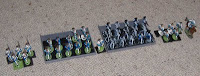 The battallion from above; the "hatmen" or centre companies have been grouped in two Grand Divisions, flanked by the elite corps.
The sharp-eyed among you will note that the centre companies are in a three-deep line with the induvidual figures offset to allow the rear ranks not to perforate the skulls of the front when offering fire.
My favoured RSM miniatures come in three main poses for the infantry; marching, advancing with the bayonet forward and a stand- and kneel-and-fire pose. I've been thinking of how to make this work for me.
In the "Drums of War" rules, a batallion is made up of two or more "Grand Divisions" and small five figure "elite companies. I had been thinking of how to make the figure poses work for me to help identify units by type on the table-top and came up with the following:
Centre Company troops (to use an anachronism) would be represented by troops in a firing-line pose.
Grenadiers would be represented by figures in the stately "march attack" pose.
Skirmishers or light troops might be represented by troops in the advancing pose.
The uniformity of pose means that there might be no gross dissimilarities of pose when elite companies were formed into ad hoc Grenadier or light batallions. Furthermore, I very much like the idea of one day being able to do the defense of the hieghts of Carillon with the Lights forming their historical piquet duties, whilst the Line fire over the log entrenchment and the Grenadiers stand steadfastly behind them, ready to seal any breach that might be made in their order.
 Note here that at the left of the line is the light company.
 At the right are the Grenadiers.
 The battallion from above; the "hatmen" or centre companies have been grouped in two Grand Divisions, flanked by the elite corps.
The sharp-eyed among you will note that the centre companies are in a three-deep line with the induvidual figures offset to allow the rear ranks not to perforate the skulls of the front when offering fire.
Saturday, November 15, 2008
The Niagara Campaign

RSM British infantry painted as 44th Foot
I've been thinking a little about the material resources I'll need to to my Fort Niagara Campaign next year.
I have been asking myself the usual questions about the sort of things I'd like to represent on the tabletop, what I am able to do on a map and what I would like to see played out in a demonstration game.
Starting with Fort Little Niagara, it seems to me that this was a simple palisaded for that guarded the start of the portage road. There seems little information on it's ground-plan, so I am assuming it was a square/rectangular palisade with a timber blockhouse at each corner. I hope that Rene Chartrands' projected third Osprey on the forts of New France can shed a little light in tim for me.
This volume will also cover Fort Niagara itself, although I have the book on the siege which reproduces the many excellent maps and cross sections of the works as they were in 1759. I hope it can resolve certain matters of detail for me. It's a model I really want to build for myself; perhaps eventually as a demonsration game, and I've enough information on it to do a reasonable reporduction.
In conjunction with this (and perhaps expanding on the thought of making this a demo game) I like the idea of using the two brigs the French had available to them to stage some amphibous operations; I find myself inspired by Hornblower.
I'm more and more tempted to use Bill Protz's "Drums of War" rules, although I have just lost my second copy. I've about torn the house apart looking for them, but no luck!
Monday, November 03, 2008
Rogers' Rangers
 Not too much to do on the weekend except watch Season 1 of Battlestar Glactica on DVD and do a little painting. I fished a few Rogers' Rangers out of my lead pile and cleaned them up. With only three poses to play with as can be seen here, you ned to vary their colour schemes to give them a little more visual interest.
 As usual, nice clean figures with a minimum of clutter to subtract from the basics - good anatomy and an elegant line. RSM Figures from the chaps at DPC. There is a URL in the comments section of this post.
I bought these because I'd both not settled on a French and Indian War project for next year at the ime and also becaise I'd never painted any of these figures - heaven knows, I think I've painted at least one or two of every other figure that DPC put out! I also think it'd be nice to use them in skirmish games.
Sunday, October 26, 2008
Light Bobs
Having nothing better to do this weekend, I dug out and rehabilitated some old, poorly painted British Light Infantry for the Fort Niagara Campaign. They are the ever-reliable RSMs, straight out of the relevant Blanford and lovely to paint. I decided to do a representative few from each of the light companies present at la Belle Famille. The sharp eyed among you will notice that the pants on a couple of the figures are white. I was looking for a means of adding a bit more variety to the very-similarly uniformed troopers and remembered the 44th wore white small-clothes in their fatal encounter on the Monongahela, ans so it went. I'll be repeating this experiment on their cousins in the Line companies as well to difference them from the men of the 46th.
 Note the unit designations on the back of the bases.
 They are the ever-reliable RSMs, straight out of the relevant Blanford and lovely to paint. I decided to do a representative few from each of the light companies present at la Belle Famille. The sharp eyed among you will notice that the pants on a couple of the figures are white. I was looking for a means of adding a bit more variety to the very-similarly uniformed troopers and remembered the 44th wore white small-clothes in their fatal encounter on the Monongahela, ans so it went. I'll be repeating this experiment on their cousins in the Line companies as well to difference them from the men of the 46th.
 Note the unit designations on the back of the bases.
I'll try to have a little skirmish game soon to try out the Drums of War rules.
Friday, October 24, 2008
Fort Niagara
 I'm starting to look at building Fort Niagara.
It's quite an unusual fortification for the French and Indian War. Most of the larger forts that the French built were more like that at Ticonderoga/Carillon, being basically a square plan with a bastion at each corner. A ravelin might cover a gate or push the defences deeper out into the surrounding terrain.
Niagara was a rather different story. Originally a rather dilapidated wooden stockade surrounding a few buildings, the French engineer Pouchot decided that he would wall in the point on which the fort would sit. That original trace may be observed in the fort today.
He built what is basically a crown-work of two demi-bastions connected by a curtain, with a large bastion covering the gate. The bastion stood in a ditch, but the lunettes either side of it that supported the covered way stood on the salient places d'armes, proud of the ditch. On closely examining the diagram and the cross-sections, it also seems to me that a shallow ditch was excavated in front of these as well, but that it was not part of the main ditch.
Much of the work was built of material excavated (as can be seen in the cross-sections in the image above) from the ditch. Obviously, the forts defences are oriented eastwards as that was the most likely avenue of attack, although the northern and southen walls were fortified to a degree with retrenchments and stakes.
The fort had two major short-comings.
The first was that it's guns were mounted to fire "en barbette" or straight over the parapets which offered the gunners little cover as the British advanced their saps. This was largely overcome by building merlons from sand-bags.
The other was that there were no bomb-proof shelters for the troops, and thus the garrison suffered quite a few caualies from British mortar bombs and also became progressively exhausted due to not being able to rest.
I'll be using this illustration and others I have to start planning my own model of the fort in coming weeks and months, so watch this space.
Monday, October 20, 2008
Drums of War...
This weekend I was lucky to have some time to myself, so I dug out some old RSM Indians and Militia who had been sitting in a box for a very long time; more than five years, if I'm right. I think these are such beautifully designed figures that I am really looking forward to painting the 80 or 90 more I'll need for the Fort Niagara campaign. They are so easy to paint that I got through ten of them in an evening. These Indians have been based to my usual "skirmish" standard - induviduals on 25mm bases, or groups of two on 50mm bases. They make for a suitably scattered and irregular grouping - just what every war-band needs.
 There is an indian firing a musket who is dressed in full buck-skins and standing ine middle of the formation who is I think, the first wargaming figure I ever painted.
 These Indians have been based to my usual "skirmish" standard - induviduals on 25mm bases, or groups of two on 50mm bases. They make for a suitably scattered and irregular grouping - just what every war-band needs.
 There is an indian firing a musket who is dressed in full buck-skins and standing ine middle of the formation who is I think, the first wargaming figure I ever painted.
 Some projects are longer in the gestation than others!
 Militia; I'm not too sure whose side they are on. I note the figure on the far left may be a coureur du bois due to his little cap, so I am guessing French..? I am pretty sure the militia in hunting shirts are probably meant to be Americans rather than Canadians, though. Who knows? Perhaps they are all simply "frontiersmen".
 Another view of the Militia. They are not such impressive figures straight out of the bag, but they paint nicely; not much more than successive layers of lighter and lighter dry brushing with a little layering-on of the final highlight, all followed with a wash of sepia ink.
 Militia; I'm not too sure whose side they are on. I note the figure on the far left may be a coureur du bois due to his little cap, so I am guessing French..? I am pretty sure the militia in hunting shirts are probably meant to be Americans rather than Canadians, though. Who knows? Perhaps they are all simply "frontiersmen".
 Another view of the Militia. They are not such impressive figures straight out of the bag, but they paint nicely; not much more than successive layers of lighter and lighter dry brushing with a little layering-on of the final highlight, all followed with a wash of sepia ink.
 In other news, work on the Victorian Navy continues in a satisfactoy way.
Thursday, October 16, 2008
In the Grim Darkness of the 41st Milennium...
... there will be only War.
 No wonder these guys look peeved.
What, they ask, about social policy? Housing? Rental support? Gays in the Military? Legalising Black Lotus?
Two of the most fiddly miniatures I've ever painted, I'd think, especially after someone* dropped a load of orange-juice over them!
These are veterans of the Tyranid War. They look jolly tough. I'm thinking of sprinkling a few of them among my tactical squads.
According to the new Codex Space Marines fluff, as Ultramarines they are the best marines ever and no-one can kill them and all other Space Marines wish they were Ultramarines, too. And the Index Astartes (which all Marines should be following - otherwise they are not allowed to game in the Emperor's stores) was written by their Primarch who was apparrently such a strategical genius that he managed to be far from the centre of the action during the Horus Heresy. That's how good he was!**
*You know who you are.
**Tongue firmly in cheek.
 No wonder these guys look peeved.
What, they ask, about social policy? Housing? Rental support? Gays in the Military? Legalising Black Lotus?
Two of the most fiddly miniatures I've ever painted, I'd think, especially after someone* dropped a load of orange-juice over them!
These are veterans of the Tyranid War. They look jolly tough. I'm thinking of sprinkling a few of them among my tactical squads.
According to the new Codex Space Marines fluff, as Ultramarines they are the best marines ever and no-one can kill them and all other Space Marines wish they were Ultramarines, too. And the Index Astartes (which all Marines should be following - otherwise they are not allowed to game in the Emperor's stores) was written by their Primarch who was apparrently such a strategical genius that he managed to be far from the centre of the action during the Horus Heresy. That's how good he was!**
*You know who you are.
**Tongue firmly in cheek.
Wednesday, October 01, 2008
The Siege of Fort Niagra - La Belle Famille
Fort Niagra's only real hope was in relief from the Army of the Ohio which Captain Pouchot, the Fort Commandant had despatched to menace the western frontier of the British colonies.
Now summoned back, they made the epic journey back and entered into combat with a British force about half their size that had been detatched to contest the approach to the fort.
They met at la Belle Famille, virtually under the eyes of the besieged garrison.
The British began by despatching 50 light infantry each from the 44th, 46th and 4th\60th Regiments. These 150 soldiers built a log wall that they rather determinedly stuck behind throughout the battle that was to come!
A little later on they were reinforced by another 150 "hatmen" from the centre companies of the 44th, 46th and the converged New York Regiment.
Again later Lt Colonel Eyre Massey brought 140 hatmen from the 46th as well as 25 Grenadiers from the same regiments rather depleted Grenadier company.
Rushing up the portage road to meet them were Six Hundred Compagnies Franches de la Marine and Two Hundred Militia.
The French might have had 250 Indian allies with them but for the fact that British allied Indians had prevailed on them to declare their neutrality in the coming fight. The "British Indians" numbered around 310 and did not participate in the fight, but joined in the aftermath, killing the wounded, scalping the slain and pursuing the survivors.
Now summoned back, they made the epic journey back and entered into combat with a British force about half their size that had been detatched to contest the approach to the fort.
They met at la Belle Famille, virtually under the eyes of the besieged garrison.
The British began by despatching 50 light infantry each from the 44th, 46th and 4th\60th Regiments. These 150 soldiers built a log wall that they rather determinedly stuck behind throughout the battle that was to come!
A little later on they were reinforced by another 150 "hatmen" from the centre companies of the 44th, 46th and the converged New York Regiment.
Again later Lt Colonel Eyre Massey brought 140 hatmen from the 46th as well as 25 Grenadiers from the same regiments rather depleted Grenadier company.
Rushing up the portage road to meet them were Six Hundred Compagnies Franches de la Marine and Two Hundred Militia.
The French might have had 250 Indian allies with them but for the fact that British allied Indians had prevailed on them to declare their neutrality in the coming fight. The "British Indians" numbered around 310 and did not participate in the fight, but joined in the aftermath, killing the wounded, scalping the slain and pursuing the survivors.
Subscribe to:
Posts (Atom)