Captain Pouchot, the French Commander at Fort Niagra had 486 men for a garrison:
Troupes de Terre: 149 men of the La Sarre, Royal Rousillon, Guienne and Pouchots' own Bearn Regiment. This last unit had actually rebuilt the fort between 1755 and 1757. I assume that they came in equal numbers from each regiment; the French practice was to create mixed detatchments to lower the risk of heavy losses to the parent unit.
Compagnies Franches de la Marine (Independant Companies of the Navy): 183 Officers and men.
Militia: 133 Officers and men - of the Detroit Militia? Can anyone help clarify this point?
Artillerymen: one Officer and 20 men. As to whether they were the royal or colonial artillery I do not know. Their small number must have meant that large numbers of troops must have been delegated to the guns' service. Dunnigan mentions that 75 fusiliers were assisting the gunners which figure I assume he derives from Pouchots' memoirs.
When Fort Little Niagra was abandoned and burned, the garrison made their way up the portage road to Fort Niagra. The Garrison at Fort little Niagra was two officers and 70 Marines and Militia strong. I would suggest that 20 of the garrison were Militia.
Pouchot also had two lake boats at his disposal.
They are described as being a brig and a schooner named the Outaoaise and the Iroquoise respectively. They were pierced both for ten twelve-pounder cannon, five to a broadside. I do not currently know their crew sizes.
Monday, September 29, 2008

The Seige of Fort Niagra -The British Order of Battle
The British Army that set out to besiege Fort Niagra consisted of 2400 Officers and men organised thus:
1330 men from the 44th and 46th Regiments.
200 men from the Light and Grenadier Companies of the 4th\60th Regiment
Two composite battalions from the New York provincial regiments organised into five companies each.
30 personnel from the Royal Artillery
Colonel William Johnstone had organised 600 warriors of the Six Nations to accompany the British Army, whilst another 276 Seneca would join the Army at Niagra. About another 69 others would drift in during the course of the Siege.
1330 men from the 44th and 46th Regiments.
200 men from the Light and Grenadier Companies of the 4th\60th Regiment
Two composite battalions from the New York provincial regiments organised into five companies each.
30 personnel from the Royal Artillery
Colonel William Johnstone had organised 600 warriors of the Six Nations to accompany the British Army, whilst another 276 Seneca would join the Army at Niagra. About another 69 others would drift in during the course of the Siege.
Sunday, September 28, 2008
The Siege of Fort Niagra
I've been thinking over what activities I would like to go through in 2009.
A few posts back I mentioned my re-kindled interest in the French and Indian War, and specifically the siege of Fort Niagra. This has led me to read BL Dunnigans account of the siege and the repulse of the French relief force at la Belle Famille. It seems to me that the forces involved on both sides were really quite modest. The French Garrison at Fort Niagra was 486 men at most. The British Army beseiging the fort was about 2300 strong.
The French Army of the Ohio that rushed headlong to it's unhappy fate at la Belle Famille consisted 800 European and 500 "Indian" troops, whilst that of the British detatchment that defeated them was less than 500 strong.
Surely then it would not be impossible to examine some orders of battle that would let this campaign be played out at 1:10 or even a 1:5 troop ratio? La Belle Famille especially would be perfectly feasable at the latter ratio.
To that end I hope that 2009 will see me play out a convention game marking the 250th anniversary of la Belle Famille, as well as privately gaming the Siege of Fort Niagra. I intend to undertake the entire campaign with RSM miniatures.
In my next post I will share the Order of Battle information I have assembled so far.
A few posts back I mentioned my re-kindled interest in the French and Indian War, and specifically the siege of Fort Niagra. This has led me to read BL Dunnigans account of the siege and the repulse of the French relief force at la Belle Famille. It seems to me that the forces involved on both sides were really quite modest. The French Garrison at Fort Niagra was 486 men at most. The British Army beseiging the fort was about 2300 strong.
The French Army of the Ohio that rushed headlong to it's unhappy fate at la Belle Famille consisted 800 European and 500 "Indian" troops, whilst that of the British detatchment that defeated them was less than 500 strong.
Surely then it would not be impossible to examine some orders of battle that would let this campaign be played out at 1:10 or even a 1:5 troop ratio? La Belle Famille especially would be perfectly feasable at the latter ratio.
To that end I hope that 2009 will see me play out a convention game marking the 250th anniversary of la Belle Famille, as well as privately gaming the Siege of Fort Niagra. I intend to undertake the entire campaign with RSM miniatures.
In my next post I will share the Order of Battle information I have assembled so far.
Wednesday, September 24, 2008
Time Out
 El Capitano - the casting is a Commander Dante of the Blood Angels. He's on permanent transfer to the Ultramarines, now.
 An angry, angry man, the Sarge. I suppose that in the grim darknes of the 41st Milennium, you'd get a bit peeved occasionally.
Trooper Womble. A lucky bulk eBay purchase snagged him and most of his comrades.

Trooper Smith. Note the extreme highlights!
 Trooper Jones. Coming to your house to set the cat on fire.
Inspired somewhat by this blog I'd been meaning to paint up some Space Marines for the fun of it.
Being a traditionalist, it had to be Ultramarines.
Because of the level of fiddly detail on them, they are a bit of a chore to paint - especially with having to highlight the edge of each and every bit of armour plate!
I havent even looked at the arms and weapons yet.
Still it's a nice change.
Friday, September 05, 2008
Is the Old School Wargaming Yahoo Group Dead?
Everything has it’s time on Earth and in time that allotted span must come to a close.
Has this happened to the Old School Wargaming Yahoo Group?
Consider:
Is there really anything NEW happening there?
Once upon a time the group was a real clearing-house for information. New members were being put in tough with like minds, a very great deal of information was being exchanged. Old miniatures lines were being evaluated, old books re-read, ideas being shared; it was a melting pot for ideas.
What is happening there these days?
It seems to me that we are going around and around in circles to the point that the group is becoming a caricature of it’s old self.
All too often we get this ridiculous self-image of the OSW member as a florid-faced retired Colonel type of figure, slurping the port and brandy whilst inflicting his foul cigars upon those about him from the comfort of his leather-padded chair.
How many times must we have the debate on what it means to be Old School? The argument always resolves on the inevitable suggestions of hail-fellow-well-met versus reminders that the old schoolers had their rather glaring faults as human beings? Everyone then just realizes that they want to have fun playing with toy soldiers.
Is the problem one where the topic is too limited? There is only so much self-indulgent “Old Schooling” that a group can chew over before all the juice of the topic is vanished?
Has this happened to the Old School Wargaming Yahoo Group?
Consider:
Is there really anything NEW happening there?
Once upon a time the group was a real clearing-house for information. New members were being put in tough with like minds, a very great deal of information was being exchanged. Old miniatures lines were being evaluated, old books re-read, ideas being shared; it was a melting pot for ideas.
What is happening there these days?
It seems to me that we are going around and around in circles to the point that the group is becoming a caricature of it’s old self.
All too often we get this ridiculous self-image of the OSW member as a florid-faced retired Colonel type of figure, slurping the port and brandy whilst inflicting his foul cigars upon those about him from the comfort of his leather-padded chair.
How many times must we have the debate on what it means to be Old School? The argument always resolves on the inevitable suggestions of hail-fellow-well-met versus reminders that the old schoolers had their rather glaring faults as human beings? Everyone then just realizes that they want to have fun playing with toy soldiers.
Is the problem one where the topic is too limited? There is only so much self-indulgent “Old Schooling” that a group can chew over before all the juice of the topic is vanished?
Friday, August 29, 2008
Guess What I'm Thinking?
Recently I've been reading my new Osprey on the Fortifications of New France (FORT 75) and I've been revisiting some very old wargaming territory.
The French and Indian War was my first love, and you never forget the first one, do you? I think this came from a few sources. One was the front cover of the 1982 Military Modelling issue which featured the new (!) Pax Britannica 28mm figure range of French and British Figures contesting a palisaded fort. Lovely figures and very well painted. Another was a uniform feature in the same magazine some time later on the FIW period. The final push was the first "real" wargames magazine I ever bought.
That was "The Courier", back when Bill Protz was the editor. He and another gentleman wrote twin articles on "The Action at la Belle Famille" wherein French forces attempting to relieve the 1759 seige of Fort Niagra were defeated at the eponymous action.
 Compagnies Franches de la Marine fire at advancing Red Men.
 The Indians in this image contain the FIRST Ever RSM/Pax Britannia figure I ever bought!
The French and Indian War was my first love, and you never forget the first one, do you? I think this came from a few sources. One was the front cover of the 1982 Military Modelling issue which featured the new (!) Pax Britannica 28mm figure range of French and British Figures contesting a palisaded fort. Lovely figures and very well painted. Another was a uniform feature in the same magazine some time later on the FIW period. The final push was the first "real" wargames magazine I ever bought.
That was "The Courier", back when Bill Protz was the editor. He and another gentleman wrote twin articles on "The Action at la Belle Famille" wherein French forces attempting to relieve the 1759 seige of Fort Niagra were defeated at the eponymous action.
 Compagnies Franches de la Marine fire at advancing Red Men.
 The Indians in this image contain the FIRST Ever RSM/Pax Britannia figure I ever bought!
I have noticed that the next volume in the FORT series that is in preparation by Rene Chartrand intends to conclude with an examination of the Forts around the Great Lakes - this includes Fort Niagra. It's a real shame that I've mis-laid/lost my copy of "Drums of War Along the Mohawk" - BARs older brother. I'll just have to buy another.
Monday, August 25, 2008
War Games and the DIY Spirit
In his introduction to “War Games”, Don Featherstone makes reference to his age being one of “Do It Yourself”.
When you read this book, you really do have this point brought home to you again and again. One pictures the Author slaving away with plaster of Paris moulds, producing the odd few soldiers before the mould falls to pieces – perhaps the odd mould explodes because the plaster of Paris was imperfectly dried out. I was minded of the author grimly gripping his hard-won casting in a pair of pliers whilst doggedly grinding away at the abundant flash with a selection of rat-tail and jewellers files, probably before going on to modify some plastic Airfix ACW types into Sassanid Persians with only a razor blade and some Plastic Wood to get him through.
War gaming in this era was tough. Really tough, especially for people without a lot of money. Retired Brigadiers could afford the best of everything, but someone with a day job and access only to the local public library laboured under special handicaps. Materials were rudimentary, unsuited or roughly adapted from many other theatres of life, it would seem to me. Every man (and I do mean every man) was an island, vainly reaching out to his few others of like mind, making contact through Model Soldier and Model Railway societies. Writing on the topic were in Mecanno Magazine (or whatever), Home Florist or some other ill-adapted, non-speciality publication, but somehow the War Gamers persevered with their damp, sand covered tables and plaster of Paris scenery.
I should note here that the three main rule-sets offered, Ancient, Horse and Musket and Modern (ie, WW2) are by Tony Bath, Don Featherstone and Lionel Tarr respectively. Interestingly, Featherstone also provides a brief set of rules for what he calls “close wars”, or what you or I would today call skirmish gaming.
What I thought most interesting about the book though was how it was seen by the author in his introductory remarks. The edition that I read was that of 1970. The book had been in publication since 1962 and gone through seven editions, for every war gamer melting type-setters lead in his kitchen there were now one hundred war gamers now using professionally made product. In 1970, war gaming was a hobby that was clearly on the move, and really one can only look back now, some thirty-eight years further on with some amazement at the changes that have been wrought on the hobby since.
What really strikes you when you read this book is the handicaps that the war gamers of this period laboured under. They really did do it themselves. And that dedication to and perseverance with the hobby is what shines through this excellent little book. The rules are simple – some would say rudimentary – but are obviously products of a time when research materials were thin on the ground and not easily accessed. Again, one imagines the difficulties that these authors laboured under.
The internet has been the salvation of the hobby, with vast amounts of product of any kind available to anyone with an internet connection and a credit card.
The DIY spirit though, is well and truly moribund.
When you read this book, you really do have this point brought home to you again and again. One pictures the Author slaving away with plaster of Paris moulds, producing the odd few soldiers before the mould falls to pieces – perhaps the odd mould explodes because the plaster of Paris was imperfectly dried out. I was minded of the author grimly gripping his hard-won casting in a pair of pliers whilst doggedly grinding away at the abundant flash with a selection of rat-tail and jewellers files, probably before going on to modify some plastic Airfix ACW types into Sassanid Persians with only a razor blade and some Plastic Wood to get him through.
War gaming in this era was tough. Really tough, especially for people without a lot of money. Retired Brigadiers could afford the best of everything, but someone with a day job and access only to the local public library laboured under special handicaps. Materials were rudimentary, unsuited or roughly adapted from many other theatres of life, it would seem to me. Every man (and I do mean every man) was an island, vainly reaching out to his few others of like mind, making contact through Model Soldier and Model Railway societies. Writing on the topic were in Mecanno Magazine (or whatever), Home Florist or some other ill-adapted, non-speciality publication, but somehow the War Gamers persevered with their damp, sand covered tables and plaster of Paris scenery.
I should note here that the three main rule-sets offered, Ancient, Horse and Musket and Modern (ie, WW2) are by Tony Bath, Don Featherstone and Lionel Tarr respectively. Interestingly, Featherstone also provides a brief set of rules for what he calls “close wars”, or what you or I would today call skirmish gaming.
What I thought most interesting about the book though was how it was seen by the author in his introductory remarks. The edition that I read was that of 1970. The book had been in publication since 1962 and gone through seven editions, for every war gamer melting type-setters lead in his kitchen there were now one hundred war gamers now using professionally made product. In 1970, war gaming was a hobby that was clearly on the move, and really one can only look back now, some thirty-eight years further on with some amazement at the changes that have been wrought on the hobby since.
What really strikes you when you read this book is the handicaps that the war gamers of this period laboured under. They really did do it themselves. And that dedication to and perseverance with the hobby is what shines through this excellent little book. The rules are simple – some would say rudimentary – but are obviously products of a time when research materials were thin on the ground and not easily accessed. Again, one imagines the difficulties that these authors laboured under.
The internet has been the salvation of the hobby, with vast amounts of product of any kind available to anyone with an internet connection and a credit card.
The DIY spirit though, is well and truly moribund.
Thursday, August 21, 2008
First Thursday Book Club
It has been on my mind for a while now to publish short reviews of "Classic" war-gaming titles on a fairly regular basis. I first turned this idea over when I made it my resolution to re-read my entire "Old School" collection over the next year.
What I am thinking of doing just now is posting once a month (or more often if I have time) a review of about 500 or so words. I'm not sure as to what criteria I'll be applying, but style, content, readability will be featuring with some sort of weighting.
The first volume I will be looking at will be Donald Featherstone's 1962 "War Games: Battles and Manoeuvres with Model Soldiers" - more this evening when I have refreshed my memory!

What I am thinking of doing just now is posting once a month (or more often if I have time) a review of about 500 or so words. I'm not sure as to what criteria I'll be applying, but style, content, readability will be featuring with some sort of weighting.
The first volume I will be looking at will be Donald Featherstone's 1962 "War Games: Battles and Manoeuvres with Model Soldiers" - more this evening when I have refreshed my memory!

I would be more than happy to take submissions on this project - if you are interested, please email me at: bloggerator@gmail.com
Wednesday, August 20, 2008
More Croats
I had the day at home yesterday and started in on some lead mountain reduction. Among other things, I had one part-completed company of Croats I wanted to knock off before I moved on with any more conversions. My companies are fifteen miniatures strong, so I had ten to do from plain metal to final blast of varnish.
Below is the first shot of the completed troops. Note that after what seemed to me a sucess with the dismounted Kurfurstin Dragoons, that I am starting to base the odd few troopers on larger bases to allow for the creation of mini-dioramas.
 The same line-up from a different angle. Note the minor conversion on a couple of the loading troopers for the sake of a little diversity in the firing line.
 The completed company with flag-bearer. I think the colour is from Frederic Aubert's site, although there are many lovely Austrian flags available, including those from the Warflag site.
 Full line-up of my Croats. I've now three full companies with another two in preparation. I expect to finish off a fourth company in the next few days.

Below is the first shot of the completed troops. Note that after what seemed to me a sucess with the dismounted Kurfurstin Dragoons, that I am starting to base the odd few troopers on larger bases to allow for the creation of mini-dioramas.
 The same line-up from a different angle. Note the minor conversion on a couple of the loading troopers for the sake of a little diversity in the firing line.
 The completed company with flag-bearer. I think the colour is from Frederic Aubert's site, although there are many lovely Austrian flags available, including those from the Warflag site.
 Full line-up of my Croats. I've now three full companies with another two in preparation. I expect to finish off a fourth company in the next few days.
Sunday, August 17, 2008
Maria Theresa's Wild Men
It seems like ages ago that I began to become interested in the less regular of the forces available to the Austrian Empire in the 1740s or so on. This project that I began at the time to start creating some of them has been on hold for a long time, but Amy and I were away on a brief holiday recently and while we were away there were a succession of rainy evenings where she read a detective novel and I got out the Greenstuff and some RSM Croats.
The images below are the painted-almost-to-completion results of a two-day painting blitz; well, it was a blitz for me!
 A few Warasdiners. New additions to the company-sized unit I am slowly putting together. It was conversions like these that opened my eyes to the potential of the RSM castings. The Officer at the right of the image is from the Russian Infantry pack to whose coat I have added a fur edging down the front. He needs some metallic lace on his waistcoat to finish him off. Had I a fine enough brush, I might have made an attempt at some gold frogging as well.
 These four figures were inspired by plate C2 of the Osprey volume on "Austrian Frontier Troops, 1740-98". They represent troops of the Ogulin Regiment in 1757. The only difference between them and the RSM sculpts is the red bag I added to the crown of the tschako and allowed to flop down one side and the modification I made to the hand that supports the musket to vary the loading pose. This latter was quite successful, I think and is one I will repeat. I am also experimenting with basing variations for my light troops to give them some more interest after good experiences with my dismounted Bavarian Dragoons.
 Above are three Hungarian infantry in the basic 174o uniform, painted as Regiment Ujvary per the print from the Vinkhuizen Collection at the NYPL. It's a simple conversion where I have painted the top of the slightly cut-down tschako red and sculpted on some fur. Perhaps the fur detail is a bit heavy, but I've exaggerated a bit for the sake of making the "furriness" obvious. It could use a thin, black wash to tone down the rather violent high-lighting on the cap, too.
 The final image here is a couple of Hungarian Soldiers from the later part of the War of the Austrian Succession, perhaps from 1745 onward. Here they have had new hats added and fur cuffs and edging sculpted onto their otherwise short coats. I am so pleased with these that I am almost certain to do a full regiment of them.
The images below are the painted-almost-to-completion results of a two-day painting blitz; well, it was a blitz for me!
 A few Warasdiners. New additions to the company-sized unit I am slowly putting together. It was conversions like these that opened my eyes to the potential of the RSM castings. The Officer at the right of the image is from the Russian Infantry pack to whose coat I have added a fur edging down the front. He needs some metallic lace on his waistcoat to finish him off. Had I a fine enough brush, I might have made an attempt at some gold frogging as well.
 These four figures were inspired by plate C2 of the Osprey volume on "Austrian Frontier Troops, 1740-98". They represent troops of the Ogulin Regiment in 1757. The only difference between them and the RSM sculpts is the red bag I added to the crown of the tschako and allowed to flop down one side and the modification I made to the hand that supports the musket to vary the loading pose. This latter was quite successful, I think and is one I will repeat. I am also experimenting with basing variations for my light troops to give them some more interest after good experiences with my dismounted Bavarian Dragoons.
 Above are three Hungarian infantry in the basic 174o uniform, painted as Regiment Ujvary per the print from the Vinkhuizen Collection at the NYPL. It's a simple conversion where I have painted the top of the slightly cut-down tschako red and sculpted on some fur. Perhaps the fur detail is a bit heavy, but I've exaggerated a bit for the sake of making the "furriness" obvious. It could use a thin, black wash to tone down the rather violent high-lighting on the cap, too.
 The final image here is a couple of Hungarian Soldiers from the later part of the War of the Austrian Succession, perhaps from 1745 onward. Here they have had new hats added and fur cuffs and edging sculpted onto their otherwise short coats. I am so pleased with these that I am almost certain to do a full regiment of them.
I'd love to do some officers in a mix of "German" and "Hungarian" uniform; pelisses, more fur hats and some flugelmutzen for instance. I'd like to investigate adding sabretaches and hussar boots to some of them at least.
Monday, August 11, 2008
Thursday, August 07, 2008
More on Castles
Continued...
Just as tower construction was a response to the perceived vulnerabilities of curtain walls, as time passed problems were experienced with defending towers.
Early, simple towers defences were basically crenellations that garnished their tops and arrow slots that pierced their sides. These allowed the archers who were the main troop type of the castle garrison to shoot out at an attacker and to sweep the face of the wall of those who pressed in too closely.
These simple wall-head defences did not however allow the defenders to prevent an enemy from attacking the base of the tower.
The eventual response was to build projecting defences that would allow fire to be directed down the towers’ faces. Called, machicolation, they were basically a gallery that stood on corbels projecting over the top of the wall. In their earliest form, they may have been of wood as at the Cave of Sueth (a remarkable “castle-in-a-cliff” reminiscent of ancient Petra in Jordan), but later were of stone. The most common form I have encountered is the so-called “box-machicolation” which pretty much was a stone box positioned over a vulnerable feature like a door for it’s defence. Just as often, they would also have an arrow loop in the front face.
A variation on this theme was the slot machicolation which cut an arrow-loop at a downward-sloping angle in the wall so that arrow-fire could be depressed to cover areas closer to the foot of the wall or tower.
Building a castle on an isolated spur or ridge was an early practise in fortification, seemingly imported from France with the original Crusaders. This may be seen today at Saone, about 30 km from Lattakieh in Syria where the well-preserved castle stands today. It’s most remarkable feature is the rock-cut fosse or ditch dug out by Moslem prisoners who left behind a remarkable 23 metre high spur of living rock that in it’s day supported a bridge over the ditch. As neat a description as any I have read runs like this:
“Lawrence of Arabia called it "the most sensational thing in castle-building I have seen". The morning mist was rolling up from the dramatic ridge on which the ruins stand, in the midst of precipitous ravines. In the distance you can see the Mediterranean. Everything here was built "big, solid and magnificent", with a key feature being the extraordinary 28m high rock monolith, which once supported a drawbridge. The monolith stands in a formidable 156m long ravine cut from the living rock, 28m deep and 14m to 20m wide, dating mainly from Byzantine times. We were taken around by a man born within the walls of the castle, when it was still possible for ordinary folk to live there. One feature he showed us: a secret spiral stairway that runs from the roof of the keep, down through the giant central pillar in floor after floor, and then through the living rock of the mountain to the river, far below. The idea, apparently, was to take besiegers from behind.”
Next time: Gates...
Just as tower construction was a response to the perceived vulnerabilities of curtain walls, as time passed problems were experienced with defending towers.
Early, simple towers defences were basically crenellations that garnished their tops and arrow slots that pierced their sides. These allowed the archers who were the main troop type of the castle garrison to shoot out at an attacker and to sweep the face of the wall of those who pressed in too closely.
These simple wall-head defences did not however allow the defenders to prevent an enemy from attacking the base of the tower.
The eventual response was to build projecting defences that would allow fire to be directed down the towers’ faces. Called, machicolation, they were basically a gallery that stood on corbels projecting over the top of the wall. In their earliest form, they may have been of wood as at the Cave of Sueth (a remarkable “castle-in-a-cliff” reminiscent of ancient Petra in Jordan), but later were of stone. The most common form I have encountered is the so-called “box-machicolation” which pretty much was a stone box positioned over a vulnerable feature like a door for it’s defence. Just as often, they would also have an arrow loop in the front face.
A variation on this theme was the slot machicolation which cut an arrow-loop at a downward-sloping angle in the wall so that arrow-fire could be depressed to cover areas closer to the foot of the wall or tower.
Building a castle on an isolated spur or ridge was an early practise in fortification, seemingly imported from France with the original Crusaders. This may be seen today at Saone, about 30 km from Lattakieh in Syria where the well-preserved castle stands today. It’s most remarkable feature is the rock-cut fosse or ditch dug out by Moslem prisoners who left behind a remarkable 23 metre high spur of living rock that in it’s day supported a bridge over the ditch. As neat a description as any I have read runs like this:
“Lawrence of Arabia called it "the most sensational thing in castle-building I have seen". The morning mist was rolling up from the dramatic ridge on which the ruins stand, in the midst of precipitous ravines. In the distance you can see the Mediterranean. Everything here was built "big, solid and magnificent", with a key feature being the extraordinary 28m high rock monolith, which once supported a drawbridge. The monolith stands in a formidable 156m long ravine cut from the living rock, 28m deep and 14m to 20m wide, dating mainly from Byzantine times. We were taken around by a man born within the walls of the castle, when it was still possible for ordinary folk to live there. One feature he showed us: a secret spiral stairway that runs from the roof of the keep, down through the giant central pillar in floor after floor, and then through the living rock of the mountain to the river, far below. The idea, apparently, was to take besiegers from behind.”
Next time: Gates...
Wednesday, August 06, 2008
Something About Castles
What follows is one of my semi-regular exercises where I try to order my thoughts on a topic.
In this case, I have continued my reading on Crusader castles in the Holy Land, necessarily concentrating on the Eleventh and Twelfth Centuries.
When the Crusaders came to the Holy Land they brought more with them than knowledge of timber motte and bailey castles. Stone castles of some complexity were already being built in France, especially in the Anjou and Poitou, and this knowledge was modified by experiencing first hand the walls of Constantinople as they transited the Byzantine Empire.
The earliest crusader castles were basically walled enclosures centering on a substantial tower called a donjon or keep. These enclosures were strengthened by towers at intervals that began as very slight constructions, being little more than buttresses in their earliest form and meanly provided with arrow-slits. As time went on, these towers became more substantial, projecting further forward from the wall to give flanking fire across the face of the curtain. This increasing size allowed the towers to be used as accommodation and storage.
More and more too, as siege engines - especially in the form of the counter-weight trebuchet - became more able to reach out and touch a work, so too were they provided with vaulted shelters to protect the garrison from bombardment. In the earliest period, though, the most successful means of attacking castles was to mine. This meant digging a tunnel beneath a wall or tower, carefully shoring it up as one went along. When complete, the tunnel was stuffed with timber and fired - this would cause the tunnel to collapse, hopefully causing the structures above to come down. The angles of towers were particularly vulnerable to this form of attack; indeed, they were also vulnerable to direct attack by covered engines that would have a good chance of levering individual stones out from the masonry wall. Another disadvantage the square tower suffered was that its flat faces were vulnerable to the smashing impact of missile fire.
Counter to this was the round, polygonal or even prow-shaped tower. The former was the most frequent expression of a defensive philosophy that tried to either deflect missile-fire or resist it directly; a circular tower is effectively made of a series of wedges, any impact upon which would tend to drive the whole structure more firmly together. They were nonetheless more difficult to build, requiring stone masons' work of the highest order and thus square or oblong towers continued to be built until the end of the Crusader period.
As time went on and experience in the siege grew, towers became if anything even more massive and broad, both to more successfully resist the earth-quakes frequently experienced in the region (and one reads frequently of fortifications damages in just these events) and to mount the siege engines that were frequently used to good effect in counter-battery efforts. Also becoming more common in guarding against both earth-quakes and mining efforts was the glacis, a very steeply-sloping ramp built up against the wall and towers. The glacis might also conceal (as would later walls) shooting galleries for shooting out at attackers. The most striking extant example of a glacis may be seen at the Crac des Chevaliers in modern-day Syria.
Crac is also a fine demonstration of a concentric castle. As the attack became more powerful in siege warfare, outer walls were added to the older simpler castles to create an outer yard or bailey overlooked by the towers of the inner ward. The inner towers overlooked the outer to facilitate shooting over them and into them should the outer ward be taken.
Next time: Wall head defenses, defensive locations, the rock-cut fosse and gates.
In this case, I have continued my reading on Crusader castles in the Holy Land, necessarily concentrating on the Eleventh and Twelfth Centuries.
When the Crusaders came to the Holy Land they brought more with them than knowledge of timber motte and bailey castles. Stone castles of some complexity were already being built in France, especially in the Anjou and Poitou, and this knowledge was modified by experiencing first hand the walls of Constantinople as they transited the Byzantine Empire.
The earliest crusader castles were basically walled enclosures centering on a substantial tower called a donjon or keep. These enclosures were strengthened by towers at intervals that began as very slight constructions, being little more than buttresses in their earliest form and meanly provided with arrow-slits. As time went on, these towers became more substantial, projecting further forward from the wall to give flanking fire across the face of the curtain. This increasing size allowed the towers to be used as accommodation and storage.
More and more too, as siege engines - especially in the form of the counter-weight trebuchet - became more able to reach out and touch a work, so too were they provided with vaulted shelters to protect the garrison from bombardment. In the earliest period, though, the most successful means of attacking castles was to mine. This meant digging a tunnel beneath a wall or tower, carefully shoring it up as one went along. When complete, the tunnel was stuffed with timber and fired - this would cause the tunnel to collapse, hopefully causing the structures above to come down. The angles of towers were particularly vulnerable to this form of attack; indeed, they were also vulnerable to direct attack by covered engines that would have a good chance of levering individual stones out from the masonry wall. Another disadvantage the square tower suffered was that its flat faces were vulnerable to the smashing impact of missile fire.
Counter to this was the round, polygonal or even prow-shaped tower. The former was the most frequent expression of a defensive philosophy that tried to either deflect missile-fire or resist it directly; a circular tower is effectively made of a series of wedges, any impact upon which would tend to drive the whole structure more firmly together. They were nonetheless more difficult to build, requiring stone masons' work of the highest order and thus square or oblong towers continued to be built until the end of the Crusader period.
As time went on and experience in the siege grew, towers became if anything even more massive and broad, both to more successfully resist the earth-quakes frequently experienced in the region (and one reads frequently of fortifications damages in just these events) and to mount the siege engines that were frequently used to good effect in counter-battery efforts. Also becoming more common in guarding against both earth-quakes and mining efforts was the glacis, a very steeply-sloping ramp built up against the wall and towers. The glacis might also conceal (as would later walls) shooting galleries for shooting out at attackers. The most striking extant example of a glacis may be seen at the Crac des Chevaliers in modern-day Syria.
Crac is also a fine demonstration of a concentric castle. As the attack became more powerful in siege warfare, outer walls were added to the older simpler castles to create an outer yard or bailey overlooked by the towers of the inner ward. The inner towers overlooked the outer to facilitate shooting over them and into them should the outer ward be taken.
Next time: Wall head defenses, defensive locations, the rock-cut fosse and gates.
Sunday, July 20, 2008
Friday, July 18, 2008
Crusaders
 As you may have guessed, these past few weeks a young man's fancy has turned to the Crusades. I've been poking around for bargains and the Black Tree Design 2nd Crusade range with it's regular 35% discounts led me to buy a unit pack of 20 foot knights which i finished painting last night. I'm only posting some pictures tonight because I had no batteries for the digital camera!
 I decided to base them two-by-two on 40mm square bases because I had a surplus of them. I normally prefer my figures singly-based and will revert to tht scheme as I go on. This has been a bit of an experiment that I may repeat later on, depending on how I feel about these with more mature reflection.
Since I bought these, I have also purchased an army deal that will net me a dozen archers, a dozen cross-bows, 9 knightly cavalry, a dozen light cavalry (which I shall treat as sergeants), two dozen armoured and armoured spearmen as well as a couple of dozen axemen. That should get me a pretty respectable army. All I'll need will be an army commander (from the Perry brothers), some Turcopoles (the Perrys again) and perhaps some allied light cavalry - I'm thinking of some eBob Mongols standing in for Petchenegs or summat - especially lovely-looking figures. Maybe even another dozen eBob Archers, too.
We'll see.
 I found that I had a couple of circular shields floating about that I determined to paint in a sort of floreate pattern per what I'd seen on the Perry miniatures websites' images of their Turcopoles and moslem figures. I wanted my army to represent the secular barons of the Kingdom of Jerusalem in the years up to the fall of Edessa in 1144, before the Second Crusade. To this end I thought to let a little Islamic style seep in.
 I'm rather pleased with how this shield turned out, hence the extreme close-up!
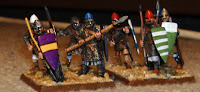
Note the purple-yellow-purple and the stripey green-and-white shields. Every medieval army I've ever painted (Bretonnians, Agincourt and now Crusades) has had a couple of knights in this livery. It's become a tradition now! I may have to come up with a story for these two knightly families. Let's see now, Odo Lecornu and Fulk Ibein. Or something like that.

A view down the battle line.

Note the purple-yellow-purple and the stripey green-and-white shields. Every medieval army I've ever painted (Bretonnians, Agincourt and now Crusades) has had a couple of knights in this livery. It's become a tradition now! I may have to come up with a story for these two knightly families. Let's see now, Odo Lecornu and Fulk Ibein. Or something like that.

A view down the battle line.
Monday, July 07, 2008
Cross-Posting!
I've written a small photo-essay on one of Colonial Victoria's warships, the jaunty little gunboat HMVS "Albert" here:
http://defence-of-melbourne.blogspot.com/
Take a look!
UPDATE: I've added a small WIP shot of one of Victoria's torpedo boats, the HMVS Nepean, here:
http://defence-of-melbourne.blogspot.com/2008/07/work-in-progress-hmvs-nepean.html
Cheers!
http://defence-of-melbourne.blogspot.com/
Take a look!
UPDATE: I've added a small WIP shot of one of Victoria's torpedo boats, the HMVS Nepean, here:
http://defence-of-melbourne.blogspot.com/2008/07/work-in-progress-hmvs-nepean.html
Cheers!
Saturday, July 05, 2008
Medieval Castles and the Operational Art
I've been doing a some supplemental reading to build up a little knowledge on medieval siege warfare after having recently finished Runciman's three-volume history of the Crusades.
I've been trying to understand what castles are for.
I understand that castles are tactically strong fortifications in the context of the weapons technology of the pre-gunpowder era, just as the artillery fortification was tactically strong after gunpowder weapons were disseminated among western armies. But just as the individual “Vauban” fortress was only one element in a larger strategic system, then so also was the castle.
The Western-European style of warfare in the Middle Ages consisted largely of sieges – the taking and holding of fortified places, including towns and castles.
Holding ground was the means by which wars were won rather than by fighting battles. Fighting battles was a risky business that, were it to go ill for you, could lose you your field army. So siege warfare was the primary means of prosecuting a war, with raiding and devastation a secondary strategy that was practiced upon your enemies' territories as a kind of economic warfare.
Your own priority was to limit the damage raiders could do you and to attack their supply-lines. Additionally you might take your army to attack the raiders whilst they were dispersed.
The Role of Castles
*Firstly we could say that they were springboards to extend one's domination beyond the limits of one's own territory.
*To jeopardize an enemy's communications or economic arteries should you have a stronghold close enough by.
*To support an advance.
*Blockade an enemy position. Counter-castles could be built to invest or baffle an enemy fortified place.
*Castles could act as store-houses for both the garrison and even to support a field army operating in the area. They might serve as an armory or mobilization store for equipping the militia.
*Defensively castles served as refuges. A defeated army might shelter in one. Local peasants and their livestock might shelter there from raiders. If relief seemed unlikely, a garrison was likely to become demoralised. Think of the collapse of virtually the whole of the Kingdom of Jerusalem after the defeat at Hattin
I've been trying to understand what castles are for.
I understand that castles are tactically strong fortifications in the context of the weapons technology of the pre-gunpowder era, just as the artillery fortification was tactically strong after gunpowder weapons were disseminated among western armies. But just as the individual “Vauban” fortress was only one element in a larger strategic system, then so also was the castle.
The Western-European style of warfare in the Middle Ages consisted largely of sieges – the taking and holding of fortified places, including towns and castles.
Holding ground was the means by which wars were won rather than by fighting battles. Fighting battles was a risky business that, were it to go ill for you, could lose you your field army. So siege warfare was the primary means of prosecuting a war, with raiding and devastation a secondary strategy that was practiced upon your enemies' territories as a kind of economic warfare.
Your own priority was to limit the damage raiders could do you and to attack their supply-lines. Additionally you might take your army to attack the raiders whilst they were dispersed.
The Role of Castles
*Firstly we could say that they were springboards to extend one's domination beyond the limits of one's own territory.
*To jeopardize an enemy's communications or economic arteries should you have a stronghold close enough by.
*To support an advance.
*Blockade an enemy position. Counter-castles could be built to invest or baffle an enemy fortified place.
*Castles could act as store-houses for both the garrison and even to support a field army operating in the area. They might serve as an armory or mobilization store for equipping the militia.
*Defensively castles served as refuges. A defeated army might shelter in one. Local peasants and their livestock might shelter there from raiders. If relief seemed unlikely, a garrison was likely to become demoralised. Think of the collapse of virtually the whole of the Kingdom of Jerusalem after the defeat at Hattin
Tuesday, June 24, 2008
Bavarian Pictures
Well, here they are, the promised pictures. First up is a fusilier from the Lacy FreiKorps. Apart from it being a compny-sized unit, I know absolutely nothing about it. I intend to build it up to 16 fusiliers and a few command - Officer, NCO and a musician perhaps. Does anyone know anything of the unit's history?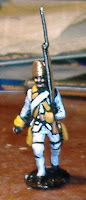 This fine fellow is a Grenadier of the Bavarian Regiment Minucci, distinguished by his pale buff facings. The uniform is from my recently-acquired copy of Herbert Knoetels "German Armies in Colour". Click on the image for a larger version. I really enjoyed how his face turned out despite using a #1 brush.

Last come are the Grenadiers from the Autrian German "Arberg" regiment. You'll note that they are painted in a version of the Austrian uniform more suited to the War of the Austrian Succession rather than that of the Seven Years' War. I enjoy how they look with their coloured small clothes.
 The figures are all from the RSM range, and some of the better ones they are, too. They are very easy to paint. I put on the blue base coats of another eleven Minucci Grenadiers this morning in a spare thirty minutes I had while I was getting ready for work.
 This fine fellow is a Grenadier of the Bavarian Regiment Minucci, distinguished by his pale buff facings. The uniform is from my recently-acquired copy of Herbert Knoetels "German Armies in Colour". Click on the image for a larger version. I really enjoyed how his face turned out despite using a #1 brush.
Last come are the Grenadiers from the Autrian German "Arberg" regiment. You'll note that they are painted in a version of the Austrian uniform more suited to the War of the Austrian Succession rather than that of the Seven Years' War. I enjoy how they look with their coloured small clothes.
 The figures are all from the RSM range, and some of the better ones they are, too. They are very easy to paint. I put on the blue base coats of another eleven Minucci Grenadiers this morning in a spare thirty minutes I had while I was getting ready for work.
Monday, June 23, 2008
Billions of Bavarians
I had quite a productive week this time around.
I painted the Grenadier Company of the Austrian German regiment Arberg – eleven figures plus the sample I painted a year ago - and individual samples for the Lacy Freikorps and the Bavarian “Minucci” Regiment. Thirteen figures in a week is a bit of productivity high for me, why, I could paint a whole regiment in a month..!
Dream on! Still it’s a nice fantasy, and I’ll probably keep it going for another week before I get back to the Victorians.
It’s starting to look like I am gathering a Bavarian Army by stealth.
I have the completed Leib Regiment and those Dragoons, the Minucci Regiment is officially commenced and I stumbled across a handful of Austrian Cuirassiers which means that the Taxis Cuirassiers (or some other regiment) are about to rear their ugly heads.
Can’t you see it happening? I’ll be painting some Brigade staff next, then I’ll just HAVE to paint the Locatelli Hussars and another regiment of Cuirassiers to balance them out, then the Infantry will start to look under represented and I’ll slate another two units there. Oh! And what about artillery?
It just goes on and on!
I painted the Grenadier Company of the Austrian German regiment Arberg – eleven figures plus the sample I painted a year ago - and individual samples for the Lacy Freikorps and the Bavarian “Minucci” Regiment. Thirteen figures in a week is a bit of productivity high for me, why, I could paint a whole regiment in a month..!
Dream on! Still it’s a nice fantasy, and I’ll probably keep it going for another week before I get back to the Victorians.
It’s starting to look like I am gathering a Bavarian Army by stealth.
I have the completed Leib Regiment and those Dragoons, the Minucci Regiment is officially commenced and I stumbled across a handful of Austrian Cuirassiers which means that the Taxis Cuirassiers (or some other regiment) are about to rear their ugly heads.
Can’t you see it happening? I’ll be painting some Brigade staff next, then I’ll just HAVE to paint the Locatelli Hussars and another regiment of Cuirassiers to balance them out, then the Infantry will start to look under represented and I’ll slate another two units there. Oh! And what about artillery?
It just goes on and on!
Thursday, June 19, 2008
Heckenfeur
What ho.
Been having a break from the Victorian military forces this week and have dug out some Austrian Grenadiers from the lead mountain that I painted some samples for quite a while ago. I am cracking on with them at quite a pace and am enjoying the results mightily.
Pictures to follow, as ever.
Recently the Duchess and I went to a crime fiction night at the local “Reader’s Feast” mega chain bookstore. I naturally drank too much (*ahem* – free booze) and made an arse of myself in general, but between spouting off too loudly about this and that I stumbled across a large-format book of Richard Knoetels water-colours. I begged and pleaded nicely enough for the Duchess to dispense cash and I made off with my prize. I was delighted to discover it included a pretty fair selection on the Bavarian army. This has led me to decide that the Minucci regiment looked very smart in their mid-blue coat, buff facings and small-clothes and will thus be my next unit after the Austrian Regiment Arberg gets done.
The Bavarian Cuirassiers illustrated in the same volume look rather tempting also, but I suspect Mr Knoetels’ accuracy* when he’s depicting the lace on the shabraques – what’s that triangular lace thing he’s got going on there?
The strength of the Australian dollar at the moment means another order will be going out to the chaps at RSM/DPC for more bags of their Austrian castings.
In other news, I see that Eureka are gearing up for a crack at the 28mm French Revolutionary Wars market with a young Napoleon and a few Grenadiers storming the bridge at Arcola way back in 1796. Will Eureka be able to get a run in an arena pretty well stitched up by Elite miniatures? Only time will tell, I suppose. They look fairly nice in the pictures on the website, though.
I hope there will be Austrians.
*Has anyone of the nit-pickers out there ever thought of putting out a book. The title could be "Correcting Knoetel" or "Mollo, Knoetel and Funcken: A nit-pickers guide" or even: "What the Ospreys got Wrong". Get to it, nit-pickers; money where mouth is.
Been having a break from the Victorian military forces this week and have dug out some Austrian Grenadiers from the lead mountain that I painted some samples for quite a while ago. I am cracking on with them at quite a pace and am enjoying the results mightily.
Pictures to follow, as ever.
Recently the Duchess and I went to a crime fiction night at the local “Reader’s Feast” mega chain bookstore. I naturally drank too much (*ahem* – free booze) and made an arse of myself in general, but between spouting off too loudly about this and that I stumbled across a large-format book of Richard Knoetels water-colours. I begged and pleaded nicely enough for the Duchess to dispense cash and I made off with my prize. I was delighted to discover it included a pretty fair selection on the Bavarian army. This has led me to decide that the Minucci regiment looked very smart in their mid-blue coat, buff facings and small-clothes and will thus be my next unit after the Austrian Regiment Arberg gets done.
The Bavarian Cuirassiers illustrated in the same volume look rather tempting also, but I suspect Mr Knoetels’ accuracy* when he’s depicting the lace on the shabraques – what’s that triangular lace thing he’s got going on there?
The strength of the Australian dollar at the moment means another order will be going out to the chaps at RSM/DPC for more bags of their Austrian castings.
In other news, I see that Eureka are gearing up for a crack at the 28mm French Revolutionary Wars market with a young Napoleon and a few Grenadiers storming the bridge at Arcola way back in 1796. Will Eureka be able to get a run in an arena pretty well stitched up by Elite miniatures? Only time will tell, I suppose. They look fairly nice in the pictures on the website, though.
I hope there will be Austrians.
*Has anyone of the nit-pickers out there ever thought of putting out a book. The title could be "Correcting Knoetel" or "Mollo, Knoetel and Funcken: A nit-pickers guide" or even: "What the Ospreys got Wrong". Get to it, nit-pickers; money where mouth is.
Subscribe to:
Posts (Atom)