Thursday, May 14, 2015

Down t'pit

Just digging through the lead pile at the moment, and just as I send the boy down the mineshaft to see what he might pull out next, my eye alights on these:

I think the mounted officer is from the mountain gun set
Hmmm. Willies. All dressed up for the Boer War. Or the Sudan. Or even rather usefully on the North Western Frontier.

The Conoisseur gun looks good with them, and I think the boy has come back, all smirched with dust and dead daddy-longlegs with...

Nineteen of the 21st Lancers, a mule-borne mountain gun (5 mules, assorted gun bits, 5 muleteers, four gunners and an NCO - one question though, are the long strips depending from their hands casting vents or walking sticks?), assorted British and Highlander infantry and enough Ghurkas to bring a tear to the old man's eye. And look, there are the sample Pathans, Boers and Zulus I ordered at the same time. And the extra Bismark I wanted to paint as General Buller.
Imagine me in khaki
Oh dear, whatever shall I paint next?

Friday, April 24, 2015

IR#40

 Well, it would seem to be a case of another week, another regiment. In this case it's they Kreytzen Fusiliers. Still waiting on flags, so the standard-bearers are not in the shot.
I'm told this was a fairly undistinguished regiment, although did see it's fair share of action in the Seven Years War. Yes, I did paint them for the fairly unique pink small-clothes. The white gaiters are a piece of semi-artistic license as I felt that black would suck a lot of the life out of the pink.

That might do me for the immediate future as I seem now to have enough Prussian infantry to be getting on with. I've also painted my way out from under my pile of RSM Prussian infantry, as well. I'll be moving onto renovating and fleshing out three or four regiments of cavalry that I have knocking about here and the it'll be time to get on with some games.

Although, as Chris said in a recent comment, I might do a few bits and bobs just for the fun of it. I have a couple of dozen von Kleist grenzers that need basing up and then too I'd love a couple of Jaeger detachments to round things out. Oops, then there are some limbers that need painting as well.

Plenty to do.

Tuesday, April 21, 2015

How Large an Army?

I am currently painting my seventh unit of RSM Prussians and in the process have just about painted myself to the bottom of my Prussian Infantry silo. Don't get too excited. There are plenty of other silos.
That being said, I laid out the first six of these 36-figure units last weekend and thought, phew, chappie, these do take up a goodly bit of the table-top, watteau?
Now, I've a French army that with a bit of stretching could easily come up to - shall we say - 10 units if infantry and 6-8 units of cavalry of thirty-six and a dozen figures respectively. I can't imagine that you could really get many more figures on a table without it collapsing under the strain and the combined weight of figures acheiving some kind of critical mass and forming a singularity. If I were to hive off some of the grenadier stands I could probably come up with a few more units as well. Likewise the Prussians. They could easily be made up to nine units of infantry if we combined the grenadier companies from the existing units and settled on 30 figure units of foot. I've three units of Horse in varius states of repair and enough bits and bobs to flesh them out.
It may be that I am at the point now of having workable armies for most occasions. The end may be in sight.
Now what do I do?

Saturday, April 18, 2015

Built Up Areas

 Change is slow to come to the Duchy of Alzheim. Still after many years of contemplation, I have finally started making the change over to using 15mm scaled buildings.
 The buildings are resin Medieval types by Hovels and not the Franklin Mint, although you might be forgiven for thinking otherwise.  They are nice buildings, decently priced and very easy to paint. I could have gone for their "European" range, but they speak to me a little too much of Belgium when I am looking for an effect more reminiscent of Bohemia and Silesia.
 I hope this picture shows what I am doing. I've taken a leaf from Keith Flint's book and standardised my town sizes. The square of felt is 12" to a side and roughly equivalent to my unit frontage. This is the smallest town size. More can be grouped together to form larger conurbations.
 A battalion/regiment/unit can defend two sides of the area. These buildings represent light cover. They are not proof against artillery fire. Only the entrenched position shown below is.
 The village below is garrisoned appropriately enough by Garrison Regiment #2. It's still awaiting its flags and standard-bearers, but is close enough to being finished to be worth photographing.

Sunday, April 12, 2015

Painting, painting, painting

As you do.

 First off, I scraped up every last RSM Prussian I could find to put together most of IR#1. Six figures (as you may recall) need to be sourced. Althouh it may not be too clear from this picture, I've decided to use the AWI marching British Officer as the standard bearer as the RSM "Cadets" just don't do it for me. The Colonel is just about ready for paint, so expect to see him soonish.
 I also scrounged up this heavy HE piece and four-horse limber. I like this gun and it will make a fine 12-pounder for my Prussians. The Limber is quite nice and the horses look fine from what I can see on the Spencer Smith website. I'll be remaining strong however!
I'm currently about 40 percent through another Prussian unit. They are shaping up to become either Garrison Regiment #2 or the du Verger Freikorps battalion. Both have quite similar uniforms and are being painted up from the RSM Russian casting which, while not perfect, is all there is available from the range to really represent these canaille.

After they are finished and providing I still have the strength to go on, I'll turn my energies to another unit of Prussian Fusiliers, possibly either FR#40 or FR#52, although the former will require a small conversion-with-paint with regard to the lapels of the figure.

I've bough some of "Body's Banners" from the Redoubt web-store to flag and even re-flag my Prussian infantry. I'm dying to see how they look in the flesh.

Tuesday, April 07, 2015

Don't you hate it when...

... you've just finished painting the first 30 figures of a 36-figure unit of RSM Prussian infantry (in the marching pose), then you reach for the little plastic bin they live in only to find that you're actually now  completely out.

And you've pledged not to buy any more lead until the end of the year.

Friday, April 03, 2015

It's taken a while, but...

... I've finally started getting around to basing up my artillery.

I'm considerably under the influence of Keith Flint's proposed games rules at this point in time and as you've guessed am moving smartly away from singly-basing everything.

I've made a start on some of my French guns and limbers.

These are a couple of middle-weight guns, something like 8 pounders. Guns, teams and limbers by RSM.

This is a heavier piece. Pretty sure it's a Holger Ericsson design. The limber an team are once again by RSM, as is the driver. I think the latter is one of the best mounted figures I've ever seen, with lovely, natural posing; a real credit to the sculptor, Steve Hezzlewood.

Next up, I'll start on my Prussian Artillery.


Saturday, March 28, 2015

IR #48 Erbprinz von Hessen-Cassel


More RSM Prussians
I'm going to take a week off painting RSM minis as I was given by madame and the kids a couple of packs of the re-engineered Tradition "Willie" Gardes Francaises for my birthday last Sunday. They look rather nice and will go well with the couple of the older Suren officers I painted up a few years back.

As to the Prussians, I have four units of Foot and three of Horse with another three units worth of foot on the blocks in the form of unpainted castings and another of Horse to be getting on with. After them, I'd rather like to do one more of foot and horse each. The former preferably as one of the Grenadier Battalions of IR 15. I mean, if you can't paint the Garde, then what's the point of toy soldiers then, eh? That ought to get the Prussiand up to a state where they can reliably match it against my French armies - eight battalions and seven squadrons once everything is all based up.

From Kronoskaf:

This Fusilier Regiment was created on July 28 1755 from Garrison Regiment XIII stationed at Minden, which had been raised in 1743, and from Wied Fusiliers. Furthermore, Dossow Fusiliers, Jungkenn Müntzer Fusiliers and Garrison Regiment IX contributed another 360 men. The new regiment also received the "old" uniforms of Wied Fusiliers. The regiment had no district to levy its troops and had to rely on recruitment.
In August 1755, the new fusilier regiment was transferred to Wesel where it replaced Wied Fusiliers while the latter took post at Minden. On May 31 1756, the Hereditary Prince Friedrich of Hesse-Cassel took command of the new regiment.
During the Seven Years' War, the regiment was under the command of:
  • since May 31 1756: Friedrich Erbprinz von Hessen-Cassel
  • from January 8 1757 to April 28 1763: Friedrich Wilhelm von Salmuth (aka Behringer)

The fruit of the past week and a halfs' painting time

Service Record
In 1756, the regiment garrisoned Wesel.
In 1757, the regiment formed part of the Prussian contingent which joined the Allied Army. On March 24, the regiment marched to Bielefeld. In mid June, it took part in a minor engagement against the French near Bielefeld. The Allied Army vainly tried to prevent the French invasion of Hanover. The regiment then retreated towards Magdeburg.
In 1758, the regiment initially served in Saxony under Prince Henry. During the Autumn, it joined Wedell in his campaign in Pomerania against the Swedes. However, the regiment was soon recalled to Saxony to defend Dresden.
In 1759, the regiment began the campaign with Prince Henri in Saxony. On May 23, it took part in an engagement against Austrian light troops at Aue. On August 6, during the Austro-Imperial invasion of Saxony, the first battalion capitulated at Leipzig but was allowed to retire freely. On August 20, part of the regiment was part of the garrison of Wittenberg who surrendered and retired to Potsdam. The second battalion took part in the defence of Dresden which surrendered on September 4. The defender were allowed to retire freely from the town and the second battalion joined Finck's Corps. Meanwhile, on September 8, the 1st battalion of the regiment took part in the Combat of Zinna where it was deployed on the left wing. It was at the recapture of Torgau.
In July 1760, the regiment took part in the unsuccessful attempt to recapture of Dresden. On August 20, it fought at the Combat of Strehla before retiring towards Torgau.
In 1761, the regiment served on the Mulde under Prince Henri.
In 1762, the regiment served in southern Saxony. On October 15, Syburg detached the regiment to get hold of the heights of Erbisdorf before Campitelli but it was surrounded and captured as soon as it debouched from the village.
N.B.: The grenadier company, which originated from the Garrison Regiment XIII, never joined the regiment and kept its former uniform until 1776. This company was converged with grenadiers from Dossow Fusiliers (2 coys) and Garrison Regiment IX (1 coy) to form the Nr. II. "Standing" Grenadier Battalion 

Friday, March 20, 2015

Done - IR Nr5

I polished off the last little steps of this project this morning - green bases and a good coating of gloss varnish.

I'm pretty satisfied with the look of the regiment so far and will now noodle away at a few grenadiers for them then finally some command in the shape of a few standards, some drummers and a colonel.

I think I spied some fusilieers in the pile, so perhaps they may be next.

Thursday, March 19, 2015

Sessions Five and Six

Again a poor photo for which I apologise.

Sessions five and six saw all the black bits painted - hats, cartridge boxes and gaiters. A little toucching up was done on the white cross belts.

I like a nice cross-belt, I do.

Then some black-brown for the muskets, , then some yellow-white-red for the pom-poms, more red for the neck-stocks. metallics on (sword-hilt, cardtridge box plate and mustket battel and bayonette and we were pretty well done. I'll do the bases in green tonight and then gloss the living daylights out of them before sitting back and waiting for my next batch of Renedra 45*40mm placcy bases. Lovely.

The eagle-eyed among you will note that I have made a belayted start on the Regiment's grenadiers. Well done you! A day or do more and I'll have them done along with the command types ans we'll have them done by my birthday this Sunday.

A very satisfactory state of affairs.

Now, on a completely unrelated note, I was reading Charge! on the bus yesterday morning as I made my liesurely way to work and noted the following passage quoted by Young and Lawford from one Captain Nolan:

"In the retreat of our army from Burgos (in the Peninsular War) three squadrons of French chasseurs charged some squadrons of our rearguard; one of these advanced to meet them; both lines pulled up and stood fast, until one Frenchman made a cut at the man opposite him, upon which both lines instantly plunged forward and engaged; the Colonel of the chasseurs was killed, most of his officers wounded and the French were driven back with heavy loss."

It is interesting how like accounts of tribal warfare this sounds. How tentative the confrontation is to begin with.

How unlikely it is that masses of horsemen will go crashing into each other.


Monday, March 16, 2015

Third and Fourth Sessions

Forgive the flash photography.

All blue coats and white belts now painted. You might be able to spy a few with their hats and gaiters painted in the background.

On we go. More black planned for this evening.

Sunday, March 15, 2015

Second Session - IR 5

At the end of the second session the hair and red coat-tails are all complete. I can still afford to be a bit imprecise at this stage as any mistakes will be covered up in later painting stages.

The red coat-tails require an fair amount of concentration due to thenumber of folds and re-entrants in the material.

In the third painting session I will paint the dark blue coats and perhaps finish up with a coat of matt varnish to protect the fairly delicate painted surfaces from any handling they may suffer. In the fourth session I'll be painting the white belt that supports the cartridge box and the white waistbelt. I will not be washing the colour on at this stage as I will be looking for good coverage at this stage of the painting process.

Saturday, March 14, 2015

Experimenting on Jacobites

 Here is the progress so far. Painting tartan is actually relatively easy, especially if you're just making it up. I've gone for fairly high-contrast designs as you can see.
The hard part. The really hard part is painting the lines on the heavily draped and folded pieces of cloth* that depend from the shoulder or are rucked up around the waist.

*Nomenclature fail.

First Painting Session

As you may surmise, I have decided to paint the unit as Infanterie-Regiment Nr 5 (Alt-Braunschweig), with straw coloured small-clothes and facings.

The first session went quite well with well thinned coats of flesh-tone and yellow-ochre going on nicely over my matt white undercoat.

I'll call the hands, faces, small-clothes and facings done.

Next time around it will be the red coat-tails and hair. Thrilling, eh?

Friday, March 13, 2015

Back to Ones Roots

I've been footling about the past couple of weeks doing anything but paint miniatures. The paintung funk is on me and I just can't bring myself to do anything much with toy soldiers.  Plastic kits are another thing and i've had a bit of fun painting an Airfix Spitfre and a couple of Emhar Whippets.

In this midst of these frolics, I noticed that I've been running this blog for about nine and a half years. The anniversary falls in August. Co-incidentally, poking around in the various plastic tubs that house my many collections of toy soldiery, I see that over that time I have actually painted quite a few large-ish units of RSM Seven Years' War figures which i have been re-basing to my newish 36-figure standard.

I appear to have enough infantry at least to do Sittangbad over twice. So, perhaps I ought to play the game.

I am tinkering with rules and am waiting on some bases from Renedra, so once those two elements are in, I think we might go forth.

While I wait, I may as well try returning to my roots and thin the RSM lead pile a bit. These are Prussians. I'm thinking of a red-faced unit with straw-coloured smallclothes.

Tuesday, February 03, 2015

Thinning the Lead Pile - GZG Miniatures

I bought these more or less on a whim about five years ago and they've languished on the lead-pile ever since. However, a friend and i have decided to do a game at Little Wars this May and we've decided on a disguised scenario based on the Israel-Hizbullah war of 2006, so these miniatures seemed appropriate.
 I've gone for an Imperial Stormtrooper crossed with Gundam look for these.
I treated painting all the armour like I was doing AFV models with washes, dry-brushing and chipping. A dozen down, nine on the blocks and another eight to paint after that.

Then it'll be a score or so of the Denizen Mid-Tech Marines I likewise bought a small eternity ago, with lots of man-portable AT missiles..

UPDATE: Just finished painting the next few of the batch:

Each squad had it's own identifying colour.
 

Sunday, January 18, 2015

A Bit of New Years' Painting

The Pikes. Looking for a basing scheme.
 Quite some time ago I bought a small pile both of the old production and the newly mastered Willie Landsknechts. I only painted a handful at the time before drifting off with the next butterfly. However since then I've been re-reading Simon Winder's "Danubia" and the bug has bitten again.

I've been rather inspired by this basing scheme.
Our Sutleress. A great comfort to the troops. Perhaps looking for the Eureka Sutlers' Wagon?
 I think I last saw Helga here on Stokes' blog. Sorry Stokes, I used you as visual reference for painting my own!
Poseurs. 1510.
Finally, a small group to show off the figures. I've been very impressed with how well sculpted and easy to paint these were. Highly recommended.

Thursday, November 27, 2014

Clearing the Painting Desk

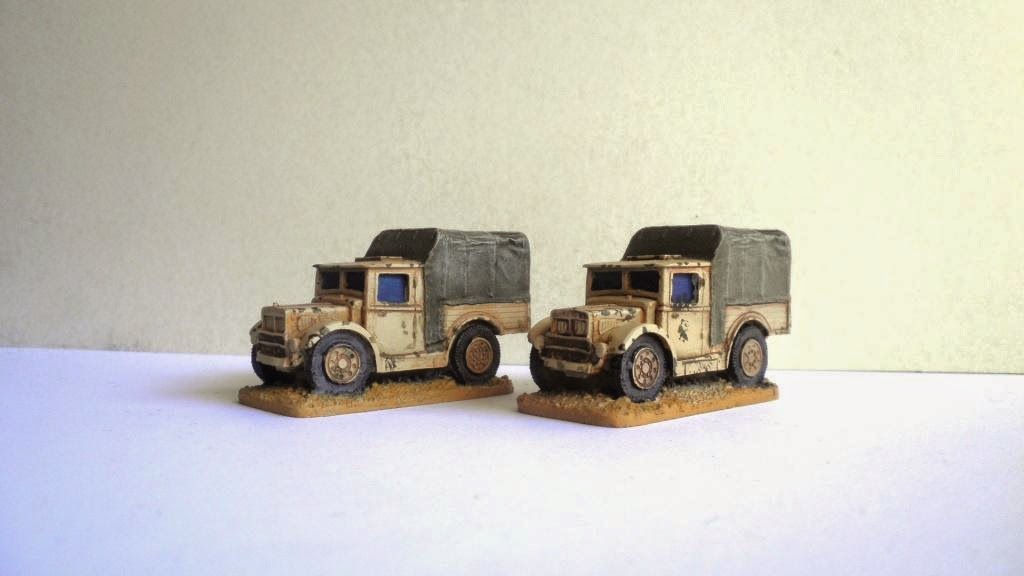
 Languishing upon my paintuing desk for almost the entirety of the year have been these half-dozen Italian vehicles.
 Trucks are by Minimi.
 Tanks are Italeri quick-builds. They've obviously had a hard life. I should do the right thing by the crews and put some sandbags on the glacis.
The L3/33 tankettes are by S-Model/Sextant.Lovely little kits and much less fiddly than the newer releases by this manufacturer.

I have one more truck waiting for me, then we're done with them for now. The top highlight is GW Bleached Bone which looks rather good over the army Painter Desert Sand which I damp-brushed up with a 50:50 mix of that and GW White. The chipping is almost the last of my long-lived pot of GW Catachan Green. The lining in is a suitable dark brown with a teeny drop of black in it.

Friday, November 21, 2014

The War to End All Bores

Hopefully.

I've been re-reading Packenham (among others) on the Boer War these past couple of weeks.

I think I have my head around the main features of the early war.

* The relative deadliness of the beaten zone - both in it's depth and in the volume of fire that could be laid down. In my mind, getting killed in a battle by missile fire is more the outcome of a lethal accident pretty much throughout history, but one that becomes more and more likely as we get closer to our own - doubtless charming - modern age.
* The difficulty that may be encountered in locating an enemy who is well concealed both by design and by the use of smokeless powder. We begin to see the emergence of the 'empty battlefield'. The relative ineffectiveness of artillery due to this issue.
*Entrenchment. Let me simply cite Magersfontein for the correct use of this expedient and Spion Kop for it's incorrect application.
*Communication was a liberating and a limiting factor I feel. Easy to disrupt and hard to maintain, the telegraph allowed improved comunication at the strategic level, but at the operational level, I believe it encouraged generals to believe they could command from the rear.
*Infantry tactics. It took more than a few disasters, and I cite again the battle of Magersfontein and the experience of the Highland Brigade who got themselves trapped 400m before the Boer lines in quarter column and were shot to pieces as they tried to deploy, before the British started to adopt open order and fire-and-movement tactics.
*Poor tactical reconaissance. Would the Highland Brigade have had it's terrible experience otherwise? Would Hart have stuck his head in the noose if he's known the trap he was walking into at Colenso? Indeed, would Long have ridden his guns into rifle range of the Boers that same fatal day? Tactical reconaissance was lacking at this time.

More as it gells. Any input would be more than welcome.


Wednesday, November 12, 2014

Falschirmjaeger...


...or some Valiant German paratroopers.

For my nephew, Max. Max, they're done! Well, almost. I just noticed a water bottle or two that I missed.

We have an arrangement where he builds them and I paint them.

Nice figures, and easy enough to paint although I would not like to do the assembly myself.