Saturday, December 23, 2006

Urban Sprawl 3


I've just about finished off my little hovel and additional walling, and am in the mood for something a little different. I have done my usual meticulous research (5 minutes googling at work) and think I might do a farm house.

The images I came away with were quite interesting, especially from this website:

http://www.spanish-inland-properties.com/farm-houses-spain/

It's amazing what prices are being asked for tumble-down ruins with no services whatsoever, but that's another story.

The accompanying picture looks rather interesting, and I think the farm could be built in the form of a number of boxes that could be basically butted up against each other and re-arranged to form a number of configurations. You seem to have a large house to which have been attached a number of newer buildings with the single-plane sloping roofs that then form "wings" and thus a yard which a stone wall has been built around.

Note the terrain. It's not quite the lush, verdant sward depicted in the touching History Terrain book on the Peninsular War!

I am also considering building an "L" shaped house - not as flexible perhaps as the "modular farm" but nice as eye-candy. I'm conceiving of it as being a high status house that might be at home in a town or in the country.

Monday, December 18, 2006

Urban Sprawl 2

I added another wall to the collection last night. Tonight I would like to add another with a simple gateway and to start work on a low-status house. I'll design this one to butt up against another structure or wall, so I'll leave two of it's walls innocent of any features.

It struck me also that I ought to loop-hole some of the walls I create. I might also do one with an embrasure cut in it.

Sunday, December 17, 2006

Urban Sprawl


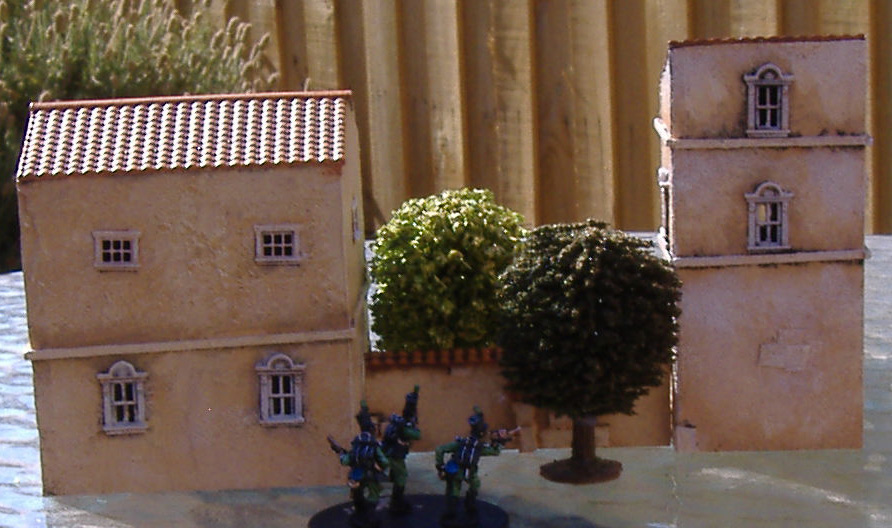
I had a few hours to myself yesterday so I went and built a few lengths of wall and the tower you can see in these pictures. Again, the materials are foam-core board and railway accessory windows. I'm out of windows! You really get through them quickly in these buildings.

I like the walling, I played around with it last night and found it's very flexible. I'll make a few more longish sections, some short ones and a gateway. I like the idea of being able to create a walled garden that I could use in the Duchy.

As ever Sean Bean's Rifles are vigilant in combing through the village and have been joined by Major Astin who is seeing to the placement of one of his precious 9-pounders. Major Astin needs a shot of varnish to finish him off.

Thursday, December 14, 2006

Peninsular House


Construction materials - foamcore walls, balsa strip, platic card for the balcony and doors, model railway windows, pantile effect plastic card for the roof. A few matchsticks to construct the roof of the balcony.

A few of Sean Bean's Rifles are included for scale purposes.

Tuesday, December 12, 2006

Write a song - win a prize!


Here's the deal.

Write me a song to the tune of "I am the very model of a modern Major-General". I'll help with the punchline - "I am the very model of a petty German Potentate". Indeed, you can play with the chorus:

Hurry up there Bauer;
The hour it is getting late;
I am the very model of;
A petty German potentate!

Or words to that effect if you please!

This will be the national anthem of the ancient and noble Duchy of Alzheim.

That's right, the National Anthem!

Madness indeed, you might say, but His Serene Highness has deemed that it is to be so, and it was only with difficulty that he was dissuaded from offering the hand of the fair princess Mathilde to the sensitive soul who sufficiently moves His Majesty.

This competition will be open until a winner is found.

Aside from the laurel of victory and the honour of becoming the Duchy of Alzheims' poet laureate, you will also win a handsome prize! Not as handsome as the Princess Mathilde, but handsome nontheless!

Marvellous, aren't they! 1/72nd Revell Austrian artillerists, freshly and pointlessly won on eBay* by yours truly. Meister Chanticleer Schwartz, you would seem well qualified in many respects to enter this competition; nonetheless, come one, come all!

*thanks to bangorstu, 100% positive feedback - quelle homme!

Am I being anal? You can tell me...

I posted this on the 7YW Yahoo Group today.

Gentlemen,

I wonder if anyone could perhaps clarify for me whether or not the Saxon Infantry wore collared coats during the 7YW?

If I may, let me take you through the reasons for my confusion.

Older visual references (Funcken, Mollo and the Knotel(?) cigarette cards on the Grosser-Generalstab website*) all show the collarless coat. This might be fair enough, but I think that they might all be working from Knotel. I do not know this for sure, but this is my feeling. My Knotel, Knotel and Seig does not confirm this one way or the other.

Newer visual references such as my Pengel and Hurt and my copy of Sapherson show the Saxons in a collared coat. Again, I think Sapherson is relying on Pengel and Hurt for his information which in turn seems derived from an illustration from 1753.

My most recent and up to date reference is Wolfgang Friedrich's "Die Uniformen der Kurfurstliche Sachsischen Armee 1683-1763". It shows collars appearing on the Infantry coats from 1742 onwards, appearing in the plates describing the uniforms for 1756 and 1760.
Is it true that there was generally a collar on the Saxon infantry uniform that did not appear on the uniforms issued to the newly reconstituted corps of infantry after Pirna? Was the collar re-introduced when the uniform changed (ie, bearskins were added) in 1760?

Is Knotel (and those who have used him since as a source) wrong? Or was Knotel right and relying on sources that may not have survived the destruction of Dresden in WW2?

Is it even possible to be so precise at two and a half centuries distance?

Any light that could be shed would be most welcome!

Best regards,

Greg Horne

*possibly the most popular, referenced and readily available visual reference available on the Saxon army on the Internet!

Wednesday, December 06, 2006

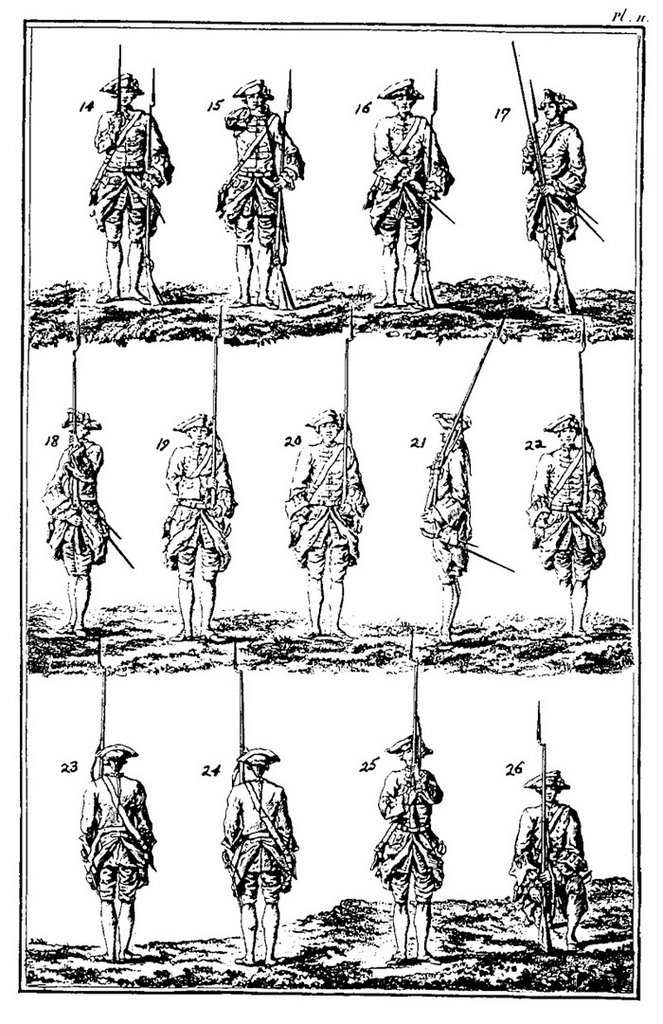
Illustrations from the French 1755 Drill Manual


In no particular order and just for interests' sake.

Tuesday, December 05, 2006

Sean Bean's Rifles


Over the past few days I have been staying busy painting these Elite Miniatures Riflemen. I love the quirky style of the sculpting which repays a fairly careful paintjob. I painted these fellows in my usual Vallejo acrylics from a white dry-brushed black undercoat. The bases they are on are their temporary "handling bases" (GW plastic ones), and are not their final bases at all. I think that the three figure vignette on the larger base looks quite nice though and may form the basis for a later grouping.

I've nearly finished painting five gunners, too and expect to have them photographed in the next few days.

I'm thinking of writing a "Sharpe" parody and calling it something along the lines of either "Sharpe's Pastiche" or even "Sean Bean's Rifles". I have been using the phrase "whoreson motherless rogue" an awful lot in the back of my head lately..!

Thursday, November 23, 2006

Painted Figures - comparison


Here they are then. From the left, Mr White Undercoat, then Mr Black Drybrushed white undercoat and finally dull old Mr Black undercoat.

Personally spraking, I think the two blck undercoats look to work the best for this type of figure. I'll try three of my RSMs next and see how they go.

The Gardes Francaises need a new draft of troops.

Wednesday, November 22, 2006

Undercoats

I decided to do a little experiment in the past few days to try out the competing “undercoat” models we have available.

I took three similar miniatures (WW1 Russians from HLBS) and undercoated them. One I did in white, one in black and one in black, heavily dry-brushed white.

I painted all three using exactly the same techniques – base-coat, first and in some areas, second highlights. Some areas got a wash of my favourite brown ink.

The HLBS castings are heavily undercut and have many a nook and cranny.

The black undercoat and the dry-brushed one let me paint the “visible” detail, while the white undercoat made me want to stick my paintbrush into every semi-accessible crevice in the figure. This is for me always a frustrating exercise and I wound up washing those areas with ink to hint at painted detail. The dry-brushed undercoat let me wash over raised strap detail without having really to paint it. I followed this up with a thinned wash of brown ink again to define the detail and it came up looking pretty good.

For comparison purposes, I ought to paint three RSM figures for comparison. They are much less heavily undercut and would make an interesting point of comparison.

Images of the HLBS figures will follow in the next day or so.

Wednesday, November 15, 2006

Touching History Terrain Book review

I received in the mail of a copy of the first volume of the Touching History series on terrain making last night, the Peninsular War one.

It’s a magazine format book with a great many illustrations showing the buildings and terrain. I was greatly impressed by the quality of the photos, but not too impressed by the information presented.

I did not feel that the book really presented me with tips on making “Spanish” terrain. The section on making the terrain boards while nice enough presented some nice grassy scenery that might not have been out of place in any generic European layout. There was no discussion at all of the differing terrain and climate conditions that one might encounter in the Peninsula. I always had the impression that Spain is rather diverse, and a bit more arid!

The buildings as describes are very nice to look at, but the emphasis seemed more on describing the finishing of the buildings than on the techniques used in making them. That’s fair enough – it’s always seemed to me that war games terrain is mostly about the finish, but a few more tips might have been useful. Some tips that were mentioned were new to me – using brass sheet to represent pantiled roofing for example – but most were pretty unremarkable and frankly could have been gleaned from the Terragenesis website or past issues of White Dwarf.

The book contains a great deal of padding and irrelevance – double-page spreads of scenery layouts, close-ups of single miniatures, close-ups of scenery layouts from irrelevant periods and an astonishingly self-indulgent couple of pages on re-enactors of the 95th Rifles. Surely some of this wasted space (and surely there’s not much space to waste in a 75-page publication) could have gone towards fleshing out the descriptions on building some of the more complicated buildings.

The problem today with this sort of publication is that there is so much material available on the internet. This material is filled with excellent, well-illustrated articles on virtually every aspect of terrain design. To produce a book on terrain building that is actually worthwhile, you may need to pitch it as being someone’s “master class” with perhaps tips on advanced techniques, perhaps some material on designing buildings from conception to execution.

I think that if you wanted to take a more useful look at creating the terrain of the Peninsula War, you might be better off hanging onto the GBP18.50 this cost me here in Australia (and spending it on some Connoisseur miniatures) and go here instead: http://www.fusiliers.net/wargaming6.htm

Tuesday, November 14, 2006

West Melbourne Regiment


I'm taking a little time off the Seven Years War to paint up something a little different.

I have a small cache of Britains recasts from Soldier Pac and got around to cleaning up one of these already pretty clean castings. They are very light on detail, so most of what you see (buttons, piping &c) are all painted on. I'm fairly pleased with the result, but think I'd have benefitted from a brush with a better point! He represents a private from the West Melbourne Regiment c1882-85. I will do a few more in the next couple of days to go with my gun crew.

At the same time I am painting a dozen Mahdist cavalry in an attempt to cut into my lead mountain. I bought these in January at CanCon and I think they look very promising so far.

Saturday, November 11, 2006

Feathery Hats

Odd title for a post?

I suppose it is. I was looking at some of my 7YW miniatures the other day and was struck by how well the feathery hat edges I'd added to a couple of mounted officers looked.

I'm the sort who likes sometimes to repeat what he regards as a success, so I started thinking that I'd like to do a few more and began casting around for a couple of units where I could have a shot.

I started thinking of the Cuirassiers du Roi in the 1740s and thought, "good, I'll do them - got a good collection of miniatures to represent a troop or two already". Then I remembered some chit chat on OSW or 7YW about Prussian IR15, the King of Prussia's own regiment. The Officers and NCOs wore feather edging in their hats.

Aha! thinks I, let's take a quick trip to Osprey-land.

One trip later and I'm a little confused. Don Fosten's magnificent plates show effectively two uniformsThe first battalion (of three) had a lapel-less coat - as some Prussian regiments did. Battalions two and three who saw a fair old bit of action had a coat with red lapels and white buttonhole edging.

Here is the question(s):

Battalions two and three can be readily modelled using RSM miniatures which come with the lapels and cuffs appropriate to battalions two and three, but did their officers and NCOs have the feathery hat edging, or was that confined to the gala-uniformed lads of the first battalion?

If they didn't, do I care and will I give them their feathery hats anyway because they look so good? Heresy!

Thursday, November 09, 2006

HE/RSM Comparison Shot


Interestingly, the two look much the same size. I had always had the impression that the HE were the smaller figures.

If anything, they are pehaps a little taller and lankier.

Tuesday, November 07, 2006

HE Infantry Figures


I finally got around to photographing some of the sample HE infantry I promised for Stokes.

Npt the best image, but they do get the "look" of them across, I think. I'd say they were as close to a "true" 25mm as you are likely to get. They look very slight against Foundry, and by comparison the detail is very unrefined.

But beautiful to me.

Wednesday, November 01, 2006

One for the Kids

I'm currently painting some more Prince August homecasts for my nephew Max. He doesn't know it yet, but he's getting some Great Northern War Saxons and Swedes to bulk out the tiny force of Saxons he already has.

I decided to write some simple rules so he can do more with them other than line them up an roll marbles at them. After all, I painted them, and want them to stay unchipped for a while yet!

1. Move
Guns – 1dice in inches
Men – 2 dice in inches
Riders – 4 dice in inches

Men or Riders with an Officer or a Drummer or a Flag Bearer get to add another dice to their move.

2. Shoot
Guns – throw 4 dice. Each 5 or 6 is a hit.
Men – throw one dice. Each 6 is a hit.
Riders – throw no dice.

Each figure that is hit but has not fired is laid down on its side and may fire once before it is removed. Riders that are hit are removed. A gun needs two men to shoot.

3. Fight
Guns – throw no dice.
Men – throw one dice.
Riders – throw two dice.

Highest score wins.

4. End of the Game
The first player to lose half of his soldiers loses the game.

Tuesday, October 31, 2006

von Bruhl Ensign


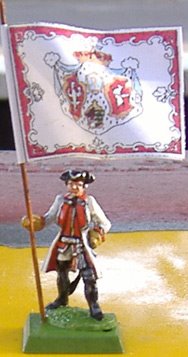
Converted from the RSM casting of a Prussian officer with a walking stick, he's had the walking stick cut away, that arm has been bent into a new pose, the hand drilled out and a wire flag-pole inserted. I also drilled a hole in the base to take the butt-end of the flag-pole for extra strength.

The flag is by RSM. That for the British Officer in yesterday's post is from the "Warflag" website; I chose a generic English flag and hand-painted the rose wreath and inscription. Our man is from the 51st Foot who fought at Minden.

Monday, October 30, 2006

RSM Ensigns


Over the weekend, I decided to convert a couple of RSM Officer figutes into more appealing ensigns than the "Cadet Standard Bearer" currently on offer.

I took the English Infantry Officer and cut his arm away from his body with a sharp blade and repositioned his arm (just a gentle bend done with my fat fingers) to take a piece of wire that would be a flag-staff.

I'm nearly finished doing another for the Graf v. Bruhl Saxon infantry regiment - I'll get an image up tonight or tomorrow.

Thursday, October 19, 2006

Break points and assymetric fighting styles.

It’s spring, the time of year when a young man’s fancy turns to kleine kreig.

I think that my sub-conscious must have been grinding away at this topic in the background. because I was cycling to work this morning and (as seems to be the case with me) apropos of nothing in particular I started thinking about Croats and Prussian Infantry.

Lets say a battalion (or any formed, regular unit, has six break points. Let’s also assume that a unit of Croats would be furnished with only five. I’m only plucking that number out of the air because it works agreeably with dice. The name “break points” could just as easily be substituted for “cohesion” points or “disruption points”.

What if, thought I, a commander of line Infantry was able to choose to open his order out at the cost of two break points? They could then act just like those rascally Croats and counter-skirmish but would be much closer to the point (let’s say three break points) where they would start to suffer unlovely consequences such as at the start of every move a dice is thrown and the number indicated is equivalent to the number of figures who have decided that now is as good a time as any to abandon the ferocious discipline of IR13 for a more felicitous regime.

Break points could be lost as a result of line losses and Officer casualties. Chaps lost to the flight to the rear would be counted as casualties. A large number of casualties in a move would lead to the loss of a DP. No officers left would equal another lost DP. Being exposed to cannon-fire might be worth a DP over and above the casualties caused.

Fleeing/ fled troops could be rallied by being joined by an officer.
Going back to our infantry sacrificing a couple of DPs to get to grips with the Croats, they’d find their advantage lay in having a higher starting number of DPs to play with. Also, as things got tricky for the line infantry, they could re-form their ranks and recover the sacrificed DPs. The Croats would not be allowed to form ranks, and would be at a fire disadvantage against formed troops in the open.

Tuesday, October 17, 2006

12 days without a post!

Unbelievable! You'd think I've run out of things to say! Or had been really busy.

Well, having set up that straw man, let me knock him down by saying I HAVE in fact been rather busy. Does that work?

Just in the past week-and-a-bit, my Eureka 100 Club submission (one I'd just about given up hope on!) has gone live.

I'm really waiting on Eureka to get a prospectus out to all those folks who expressed interest in my Arquebusiers de Grassin (and thanks to all of you who've hung in there) to confirm their interest and we are on. I spoke to Nic today and he expects three comand, and 4 or 5 skirmishing poses. I remarked to him that his line of skirmishing "ragged continentals" had greatly impressed me, so those are the spread of poses we'll be looking at.

I've also been swapping info via TMP (under the byline "jetboy" - it's a short story with no place here!) with another gent here in Australia on the Saxon Army in the mid-18th Century for another Eureka 100 Club submission which has also just about gone live.

Eureka will be getting very used to sculpting tricornes, I'd say! If anyone out there has an idea for some unique project they want to get off the ground, there are worse places to start.

I promise to get on with the Alzheimer-Vulgarian skirmish soon. Donald? How's your availability?